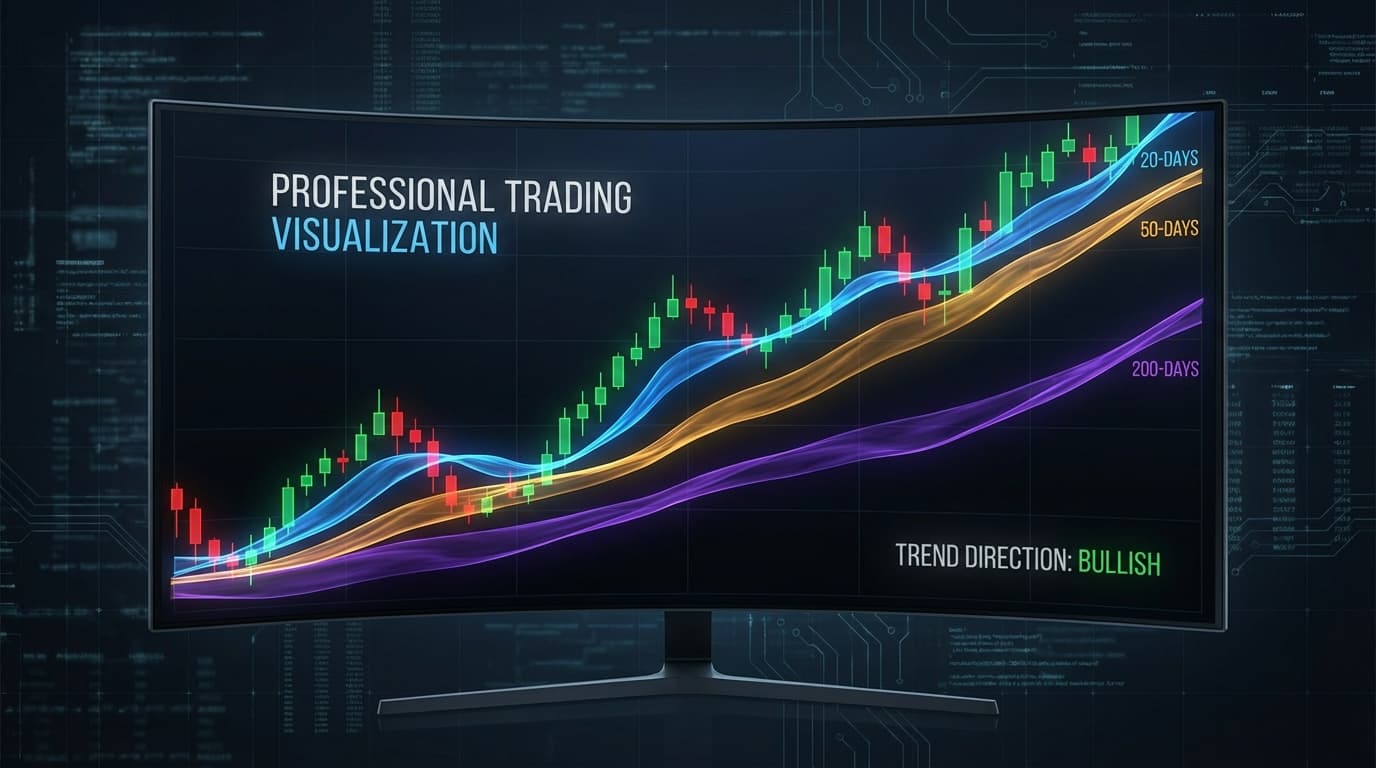
Despite the limitations of crossover systems, moving averages have genuine utility in three specific applications.
**1. Trend Direction Filter (Highest Value)**
Is price above or below the 200-day SMA? This single question — which takes 2 seconds to answer — filters out most major bear market entries for long strategies.
Lo (2004) analyzed the 200-day SMA as a market-timing rule and found that being in the market only when price is above the 200-day SMA captures approximately 70% of bull market returns while avoiding most major drawdowns. It is not an entry signal — it is a permission filter.
Professional application: Only take long setups when price is above the 200-day SMA AND the 200-day SMA is sloping upward. Only consider short setups when price is below the 200-day SMA AND it is sloping downward.
**2. Dynamic Support and Resistance**
In trending markets, price frequently pulls back to specific moving averages before continuing. The 20 EMA, 50 SMA, and 200 SMA act as dynamic support/resistance because large numbers of traders watch these levels and place orders at them.
The 50-day SMA is particularly important for stocks: institutional portfolio managers commonly use it as a reference for adding to or trimming positions. When a quality stock in an uptrend pulls back to the 50-day SMA with declining volume, it is often the institutional accumulation zone — the setup Mark Minervini calls the "pocket pivot."
**3. MA Slope as Trend Quality Indicator**
The angle (slope) of a moving average measures trend quality better than most oscillators. A 20 EMA that is steeply sloping upward indicates a strong, fast-moving uptrend. A 20 EMA that is nearly flat indicates a range, making trend-following entries low-probability regardless of other signals.
Measure MA slope visually: if the MA looks nearly horizontal, avoid trend-following entries. If it is clearly angled up or down, trend signals are more likely to work.