
Updated: 2026-03-08

Support and Resistance Trading: How Professionals Use Price Levels

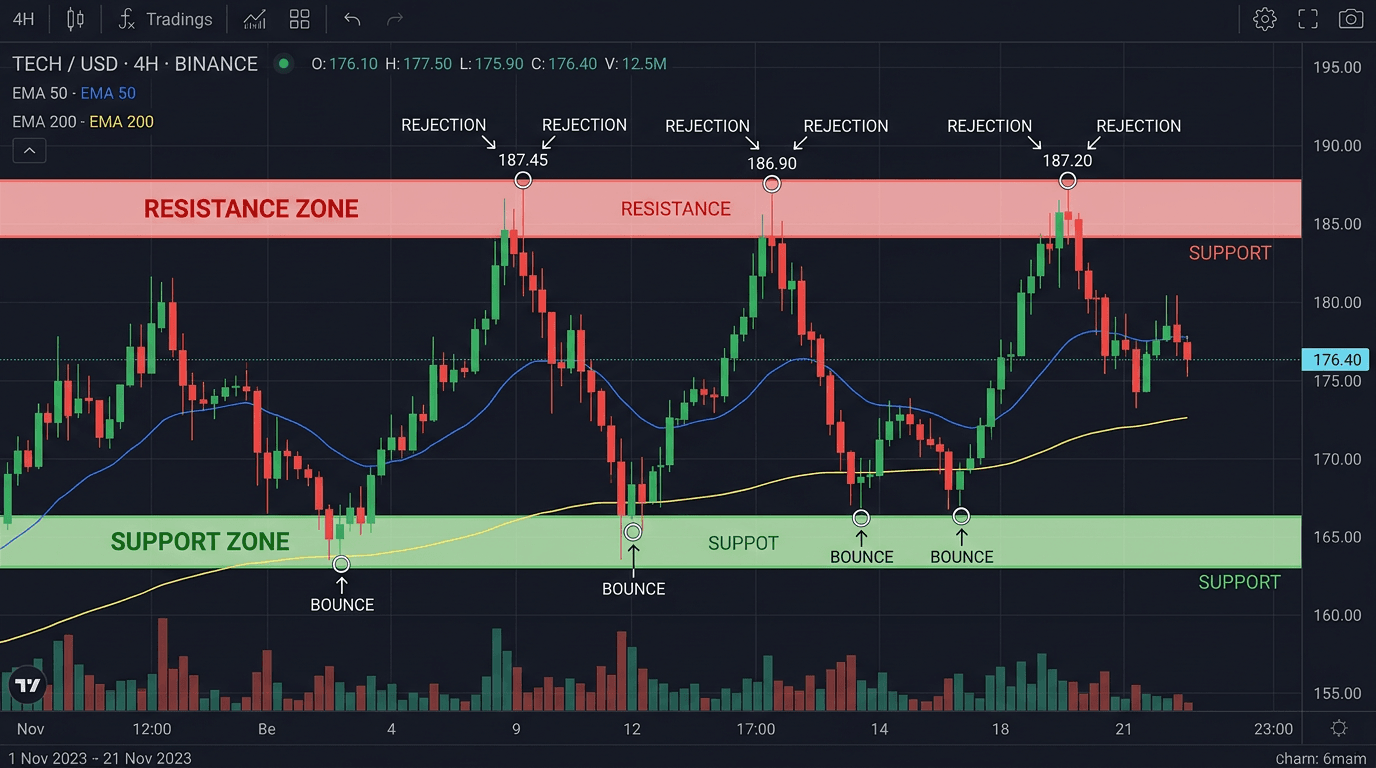
Support and resistance are the most fundamental concepts in technical analysis, and also the most frequently misapplied. A support level is a price zone where demand has historically exceeded supply — where buyers have stepped in repeatedly to halt price declines. A resistance level is the opposite: a zone where supply has historically exceeded demand, where sellers have repeatedly absorbed buying pressure. The critical word in both definitions is 'zone' — not 'line.' Markets are not precise. Support and resistance are areas of price interest, not exact levels where you set your order to the penny. A 2021 survey of proprietary trading firms published by the Society of Technical Analysts found that 94% of their traders used support and resistance as primary or secondary decision inputs — more than any other technical tool. Yet the retail failure rate at support/resistance setups remains high because most traders treat the levels as price magnets rather than probabilistic zones. This guide explains how professional traders identify, grade, and trade support and resistance levels — and how to build a journaling system that tells you which of your levels are actually producing edge.
Track your patterns free →No credit card · Free forever
Support and Resistance Trading: How Professionals Use Price Levels

How to Identify Valid Support and Resistance Levels

Not all price levels are equal. A valid support or resistance level has three characteristics: significance (it was created by a meaningful price move, not noise), recency (it was tested within a relevant time frame), and multiple touches (price has reacted at this level at least twice). Levels created by single-touch reactions are hypothesis, not evidence. Levels that have been tested and held three or more times with clear rejections are high-confidence zones.

The most significant support and resistance levels are created by specific structural events: prior swing highs and swing lows on higher timeframes, supply and demand zones where price made a sudden strong move (indicating institutional order flow), psychological round numbers (100, 1000, 0.50, 50,000), volume clusters from Volume Profile analysis (high-volume nodes become support, low-volume zones are air pockets), and prior daily/weekly/monthly highs and lows. Prior highs become support when broken (support becomes resistance, resistance becomes support — known as the principle of polarity). This polarity principle is one of the most reliable structural observations in all of technical analysis.

  • Valid level: meaningful origin (not noise), tested at least twice, clear rejection evidence
  • Strongest levels: prior swing highs/lows on weekly or daily timeframe
  • Supply/demand zones: areas where price made a sudden directional impulse
  • Psychological round numbers: $100, $1000, $50,000 — widely watched by participants
  • Volume Profile: high-volume nodes = support; low-volume air pockets = fast-move zones
  • Polarity principle: broken support becomes resistance, broken resistance becomes support

How to Grade Support and Resistance Strength

Not all levels deserve equal respect. Professional traders grade their levels by strength before deciding how to trade them. A grade-1 level has: a weekly or monthly timeframe origin, three or more confirmed touches with strong rejection candles, current confluence with a major moving average (50 or 200 SMA/EMA), and alignment with a psychological round number. A grade-1 level gets a wide stop and full position size.

A grade-2 level has: a daily timeframe origin, two touches with decent rejection, no major moving average confluence. It still deserves a trade but gets a tighter stop and 50–75% position size. A grade-3 level — single touch, intraday origin, no structural significance — is a hypothesis, not a trade location. Most retail traders trade grade-3 levels as if they were grade-1, which explains why they get stopped out repeatedly at support before the 'actual' level holds.

Grading is not complexity for its own sake. It is a discipline that prevents you from treating a noise-created level the same as a major weekly swing point.

  • Grade 1: weekly/monthly origin, 3+ touches, MA confluence, round number — full position
  • Grade 2: daily origin, 2 touches, no MA confluence — trade with reduced size
  • Grade 3: single touch, intraday origin — do not trade without additional confluence
  • Always check: what timeframe created this level? Is this level on the higher timeframe chart?
  • More touches at a level = stronger psychological significance, but also more likely to break
  • A level tested many times without a clear break is being absorbed — breakout risk increases

Bounce Setups vs. Breakout Setups: When to Fade and When to Follow

The two primary strategies at support and resistance are the bounce and the breakout. The bounce strategy fades the level — buy support, sell resistance — and targets the opposite side of the range. The breakout strategy follows the break — enter in the direction of the break after confirmation — and targets measured moves beyond the level.

Bounce setups require: a clear rejection candle at the level (pin bar, engulfing, or strong close), declining volume on the approach (seller exhaustion at support, buyer exhaustion at resistance), and entry on the first candle after the rejection with a stop below the level. The target is the next significant level on the same timeframe.

Breakout setups require: a close beyond the level (not just a wick or intrabar spike), above-average volume on the break candle, and a successful retest of the broken level from the other side (former support now acts as resistance, or vice versa). Entering on the retest — rather than the initial break — reduces false breakout risk significantly. A breakout that fails to retest and immediately reverses is a 'fakeout' — one of the most reliable counter-trade setups in the market.

  • Bounce: rejection candle + declining volume on approach + stop beyond the level
  • Breakout: close beyond level + above-average volume + retest confirmation
  • Enter breakouts on the retest, not the initial break — reduces fakeout risk
  • Fakeout (false breakout then reversal): often a high-probability counter-trade setup
  • Bounce targets: opposite side of range, next support/resistance level
  • Breakout targets: measured move = height of prior range projected from breakout point

Track Your Support and Resistance Setups — Know Which Levels Actually Work

Log each support/resistance trade with level grade, setup type, and confirmation signal. Tiltless calculates your win rate by level quality so you can cut the low-grade setups that are costing you money.

Start Tracking S/R Trades — Free

Support and Resistance Zones vs. Lines: The Critical Distinction

Professional traders draw zones, not lines. A level created by three swing lows at $100.12, $100.34, and $99.89 is a zone from $99.89 to $100.34, not a line at $100.00. Drawing a single horizontal line at $100.00 and placing your stop at $99.95 will get you stopped out by the natural variance in the zone.

The standard zone width is the candle body (or close-to-close) range of the touches, not the wick extremes. Wicks probe beyond zones by design — stops sitting at wick extremes get hunted. Your stop should be placed beyond the zone, not at the zone's edge. For a support zone from $99.89 to $100.34, a stop at $99.60 — below the deepest wick in the zone — respects the natural volatility of the level.

Wider zones are not worse than tight lines — they are more honest about market behavior. A wide zone with a clear stop location and a favorable risk-to-reward target is a better trade than a tight line where you are constantly stopped out before the actual reaction.

  • Draw zones, not lines — capture the full range of the level's historical touches
  • Zone width: use close-to-close range of the touches, not the full wick-to-wick extreme
  • Stops go beyond the zone, not at the zone edge — avoid wick stop hunts
  • A wider zone with a clear stop is more honest and more tradeable than a tight line
  • Wicks probing beyond zones are normal market behavior — do not set stops at wick extremes
  • The zone should feel uncomfortable to enter — if it is easy, you are drawing the line, not the zone

The Most Costly Support and Resistance Mistakes

The most expensive mistake is cluttering your chart with too many levels. When every minor price reaction gets marked as 'support' or 'resistance,' you have no tradeable information — you have noise. The rule: only mark levels that a professional trader would notice without any indicators. If you need a magnifying glass to justify the level, it is not a level.

The second costly mistake is treating support and resistance as permanent. Levels expire. A daily support level that was significant in October 2024 may be completely irrelevant in March 2026 if the market has traded through it multiple times and price structure has reset. Audit your charts periodically and remove stale levels.

The third mistake is entering at the level without confirmation. Support is a zone where price might bounce — not a guarantee. Waiting for a rejection candle with a confirmed close adds a filter that reduces false signals without materially worsening entry price. The difference between buying because 'price touched support' and buying because 'price rejected support with a pin bar closing mid-range' is the difference between random and systematic.

  • Only mark levels visible to a professional trader without indicators — eliminate clutter
  • Levels expire — audit charts monthly and remove stale or violated levels
  • Never enter at the level without confirmation — wait for rejection candle
  • The 'touched support' entry is random; the 'rejected support with close' entry is systematic
  • Tested too many times without a break = level is weakening, not strengthening
  • After 4+ failed tests, a level is more likely to break than hold on the next test

How to Journal Support and Resistance Trades

Support and resistance trading is uniquely journalable because you can pre-identify the level before the trade happens and evaluate your setup quality objectively after the fact. For each trade at a support or resistance level, log: the level grade (1, 2, or 3), the setup type (bounce or breakout/retest), the timeframe of origin, the number of prior touches, the confirmation signal (pin bar, engulfing, none), the volume context at the touch, and whether the trade reached target or was stopped.

The most valuable analysis: filter your win rate by level grade. If your grade-1 level setups produce a 60%+ win rate and your grade-3 setups produce a 35% win rate, you have clear evidence to stop trading grade-3 setups. This is the kind of behavioral change a journal enables — not because you didn't know grade-3 setups were lower quality, but because you can now see the cost in actual dollars.

  • Pre-identify levels before the session — evaluate setup quality objectively after
  • Log: level grade, setup type, timeframe origin, prior touch count, confirmation signal
  • Record volume context at the touch — was volume declining (exhaustion) or surging (breakout)?
  • Filter win rate by level grade after 40+ trades — your data will confirm the grading matters
  • Most traders find grade-3 setups subtract from P&L — the journal makes the cost visible
  • Use your journal data to build a pre-session level grading worksheet

Related Resources

FAQ

?What is support and resistance in trading?

Support is a price zone where buying pressure has historically exceeded selling pressure, causing price to bounce upward. Resistance is a price zone where selling pressure has historically exceeded buying pressure, causing price to reverse downward. These zones are identified by prior swing lows (support) and swing highs (resistance). The most reliable levels have multiple confirmed touches with clear rejection candles and are visible on higher timeframes (daily, weekly).

?How do you identify strong support and resistance levels?

Strong support and resistance levels have three characteristics: significant origin (created by a strong price move, not noise), multiple touches (tested at least two to three times with clear rejections), and higher-timeframe visibility (visible on the daily or weekly chart without needing to zoom in). Additional strength factors: confluence with major moving averages (50/200 SMA), alignment with psychological round numbers, and high-volume node coincidence from Volume Profile analysis.

?How do you trade support and resistance breakouts?

For a valid breakout trade: (1) Identify the key level. (2) Wait for a full candle close beyond the level with above-average volume. (3) Do not enter on the initial break — wait for the retest. (4) On the retest, enter when the broken level is confirmed as new support (former resistance) or new resistance (former support) with a rejection signal. (5) Target a measured move equal to the prior range. A breakout that fails the retest and reverses is a fakeout — often a high-probability counter-trade in the opposite direction.

?How is support different from resistance?

Support is a price zone below the current price where historical buying demand has caused price to bounce. Resistance is a price zone above the current price where historical selling supply has caused price to reverse. When support is broken convincingly (with a full candle close below and volume confirmation), it often becomes new resistance going forward — and vice versa. This flip is known as the polarity principle and is one of the most reliable structural observations in technical analysis.

Track Your Support and Resistance Setups — Know Which Levels Actually Work

Log each support/resistance trade with level grade, setup type, and confirmation signal. Tiltless calculates your win rate by level quality so you can cut the low-grade setups that are costing you money.

Support and Resistance Trading: Professional Guide