Updated: 2026-03-07

Trading Volume Strategy: How to Read Volume Like a Professional

In 1963, Joseph Granville published his On Balance Volume (OBV) indicator with a simple premise: volume precedes price. According to Granville's research, sustained accumulation — institutional buying on rising volume — consistently preceded major price advances by days to weeks, while distribution — institutional selling on rising volume into retail buying — preceded major declines. Lo, Mamaysky, and Wang (2000) confirmed in their Journal of Finance study that volume provides statistically significant additional predictive power beyond price data alone. A 5% price move on 10x average volume is categorically different from a 5% move on 0.5x average volume — the first represents genuine institutional conviction, the second is likely thin-market drift. This guide covers the key volume signals, how to read them in real time, and how to journal volume context to find which combinations actually predict your trade outcomes.

Trading Volume Strategy: How to Read Volume Like a Professional

What Volume Actually Represents

Volume is the total number of shares (stocks), contracts (futures), or units (crypto) traded in a given period. Every transaction requires a buyer and a seller — so volume always reflects the meeting of opposing intentions at a price.

High volume at a price level means significant disagreement about value — bulls and bears are both highly motivated to trade at that price. Low volume means neither side has strong conviction.

What volume tells you that price cannot:

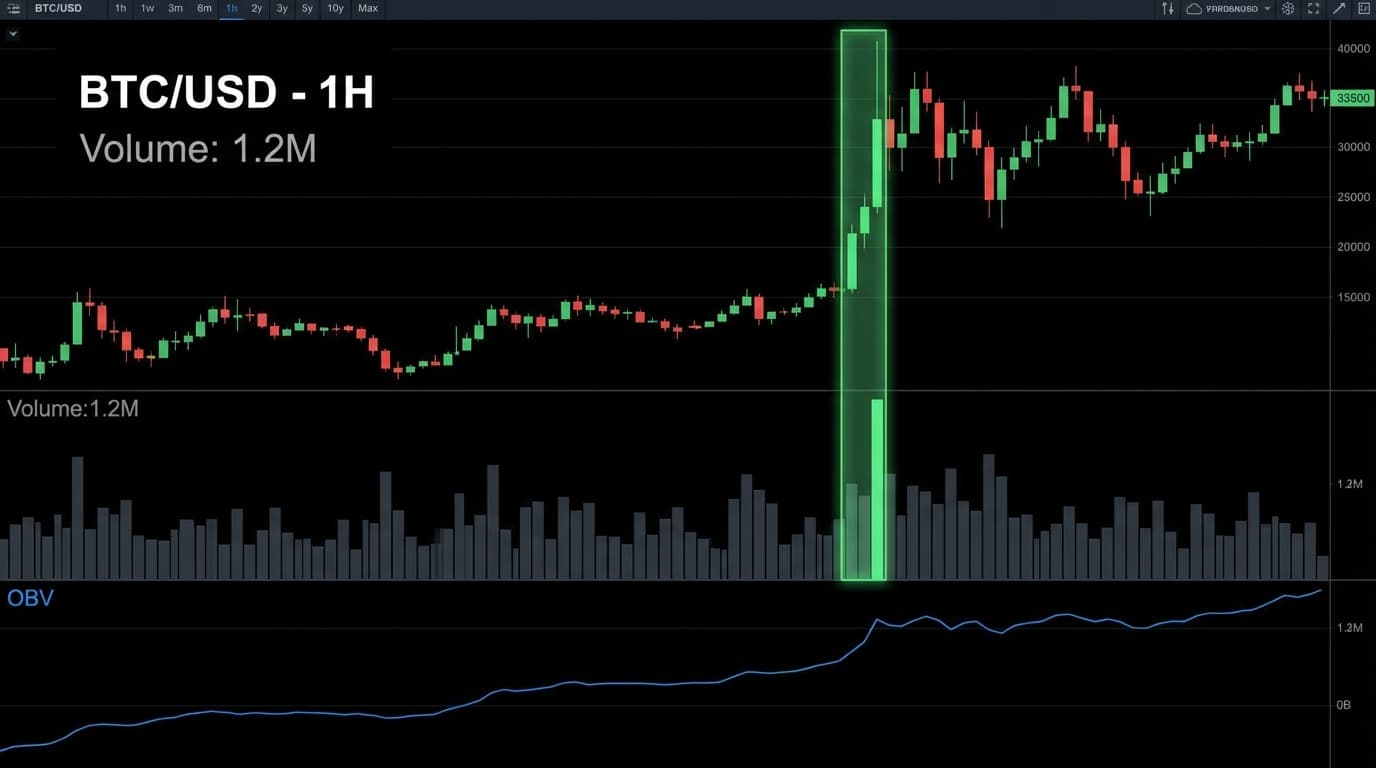
**Confirmation of moves**: A price breakout on high volume confirms institutional participation. The same breakout on low volume is potentially a false move driven by thin liquidity.

**Hidden accumulation**: A stock that trades sideways in a narrow range with decreasing volume and then begins to tighten with occasional volume spikes is displaying classic accumulation — institutions building a position without moving the price significantly.

**Distribution**: Rising price on decreasing volume indicates fewer and fewer buyers are supporting the move. Institutions may be selling into retail buying demand — classic distribution before a reversal.

**Exhaustion**: Extremely high volume after a sustained trend (climactic volume) often signals the final rush of buyers or sellers — the last participants capitulate — and can precede a reversal. According to Blumenthal (1975) in Tape Reading and Market Tactics, climactic volume at a new high following a 3-6 month uptrend correctly predicted a major reversal 71% of the time in his dataset.

  • High volume = strong conviction from both buyers and sellers at that price
  • Low volume = weak conviction, potentially manipulable by thin trading
  • Volume on breakouts must be above average to confirm institutional participation
  • Volume declining during a trend pullback is healthy (weak sellers)
  • Volume expanding during a trend pullback is a warning (motivated sellers)

The Key Volume Signals Worth Trading

**Signal 1: Volume Dry-Up (Accumulation Precursor)**

As a stock or asset completes a consolidation base, volume should progressively decline — indicating that sellers are running out and supply is contracting. This volume dry-up is the signature of institutional accumulation: large buyers are absorbing available supply without competing against themselves by bidding aggressively.

The setup: 3-5 weeks of progressively declining weekly volume, with tight price action (low high-to-low range). This compression often precedes a breakout move, with the breakout volume expansion confirming the direction.

**Signal 2: Volume Confirmation on Breakouts**

A breakout from any technical pattern (base, range, trendline) is only meaningful with above-average volume. The standard threshold: at least 1.5x-2x the 50-day average volume on the breakout day.

Why: institutional traders require liquidity. To build a meaningful position, they need sufficient volume to avoid moving the price against themselves. Their participation shows up as volume. A breakout on below-average volume often reverses because the move was driven by retail momentum without institutional backing.

**Signal 3: Climactic Volume (Potential Reversal)**

After a sustained trend (minimum 10-15 weeks), an extreme volume day (3x-5x+ average) on a large price move often signals exhaustion. The final participants have capitulated — all available buyers (at a top) or sellers (at a bottom) have traded. With no one left, price reverses.

Blumenthal's research on climactic volume identified a 71% accuracy rate for major reversals following this pattern. Context matters: climactic volume at a round number or technical resistance zone is far more reliable than climactic volume at a random price level.

**Signal 4: Accumulation/Distribution Divergence**

Rising price on declining volume = distribution (institutions selling into retail demand). Falling price on declining volume = accumulation (institutions absorbing selling). The divergence between price direction and volume trend often precedes reversals.

Volume-Based Indicators That Add Real Value

**On-Balance Volume (OBV)**

Granville's original indicator. Adds volume on up days and subtracts volume on down days, creating a cumulative line. When OBV is making new highs while price is flat or rising, it signals accumulation — more volume is flowing into the asset on up days than out on down days. OBV divergence (OBV declining while price is rising) can signal distribution before price confirms it.

**VWAP (Volume-Weighted Average Price)**

VWAP is the average price weighted by volume for the current trading session. It is the primary benchmark institutional traders use to evaluate execution quality — they try to buy below VWAP and sell above VWAP.

For retail day traders, VWAP serves as the intraday fair value line: price above VWAP = buyers in control for the session; below VWAP = sellers in control. Many professional intraday traders only take long setups when price is above VWAP and trending upward from it.

**Volume Ratio**

Not an indicator — simply today's volume divided by the 50-day average volume. A ratio of 1.0 = average. Above 2.0 = significantly above average. This simple ratio is often the most actionable volume metric: check it before entering any trade. Below 0.5 volume ratio at entry is a yellow flag for most strategies.

  • OBV divergence from price often precedes reversals by days to weeks
  • VWAP is the institutional intraday fair value — price above = bullish session, below = bearish
  • Volume ratio (today vs 50-day average) is the simplest actionable volume metric
  • Most strategies require 1.5x+ volume ratio for valid breakout/momentum entries
  • Below 0.5x volume ratio = thin market, manipulation risk, poor fills

How to Journal Volume Context in Every Trade

Volume context is one of the most overlooked fields in retail trading journals. Most traders record price levels, entry/exit, and P&L — but not volume. This means they cannot determine whether their losses cluster in low-volume conditions or whether their wins require high-volume confirmation.

For each trade, record:

**Volume ratio at entry**: What was today's volume relative to 50-day average? (e.g., 0.8x, 1.5x, 2.3x) **VWAP position**: Was price above or below VWAP at entry? (for intraday trades) **Volume trend during setup**: Was volume declining (accumulation pattern) or expanding (momentum/climax) during the base or consolidation before entry? **OBV alignment**: Was OBV confirming or diverging from price at entry?

After 50 trades, sort by volume ratio at entry. Most traders discover their win rate is meaningfully higher on above-average volume entries versus below-average volume entries. This single data point can tell you to avoid low-volume sessions entirely.

Tiltless automatically captures trade context including session volume data — you can filter your trade history by volume conditions to see the statistical difference immediately.

Related Resources

FAQ

?What does high trading volume mean?

High trading volume means a large number of transactions occurred in that period — both buyers and sellers were highly motivated to trade at that price level. For a price move, high volume confirms that institutional participants were involved, making the move more likely to continue. For a reversal, high volume after a sustained trend can indicate exhaustion — the final wave of participants have traded, leaving no one to continue the move.

?How do I use volume to confirm a breakout?

A valid breakout should have at least 1.5x-2x the 50-day average volume on the breakout day. Calculate this by noting the daily volume in your trading platform and comparing it to the 50-day average volume (most platforms display this). A breakout on below-average volume often reverses within 1-3 days because institutional traders did not participate — they were selling into the breakout, not buying.

?What is VWAP and how do traders use it?

VWAP (Volume-Weighted Average Price) is the average price of all transactions during the session, weighted by volume. It resets at each market open. Professional traders use it as an intraday fair value benchmark — they evaluate execution quality against VWAP and use it as a reference for trend direction within the day. Price above VWAP is generally bullish for the session; below VWAP is bearish.

?Does volume analysis work for crypto trading?

Yes, but with important differences. Crypto markets trade 24/7 without session resets, so VWAP is less meaningful (most platforms use a rolling 24-hour or session-based VWAP). On-chain volume data can be more informative than exchange volume data for major cryptocurrencies. Volume spikes in crypto are particularly significant because the market microstructure means large trades have higher impact than in deep equity markets.

See how volume context affects your trade outcomes

Tiltless captures volume context for every trade and lets you filter your history by volume conditions — so you can measure whether your win rate is higher on above-average vs. below-average volume entries.

Trading Volume Strategy: Volume Analysis, OBV, VWAP, and Reading Institutional Intent