
Updated: 2026-03-08

VWAP Trading Strategy: Complete Guide for Active Traders

VWAP — defined as the Volume Weighted Average Price — calculates the average price at which a security has traded throughout the day, weighted by volume at each price level. According to research by Berkowitz, Logue, and Noser (1988) on transaction cost benchmarking, institutional traders who use VWAP as their execution benchmark reduce market impact costs by an average of 18–22 basis points compared to those using simple time-weighted benchmarks. This is why virtually every institution, hedge fund, and algorithmic trading desk uses VWAP — not just as a price indicator, but as their primary execution target. Retail traders who understand how VWAP actually works — and how institutions interact with it — gain a significant informational edge in intraday markets.
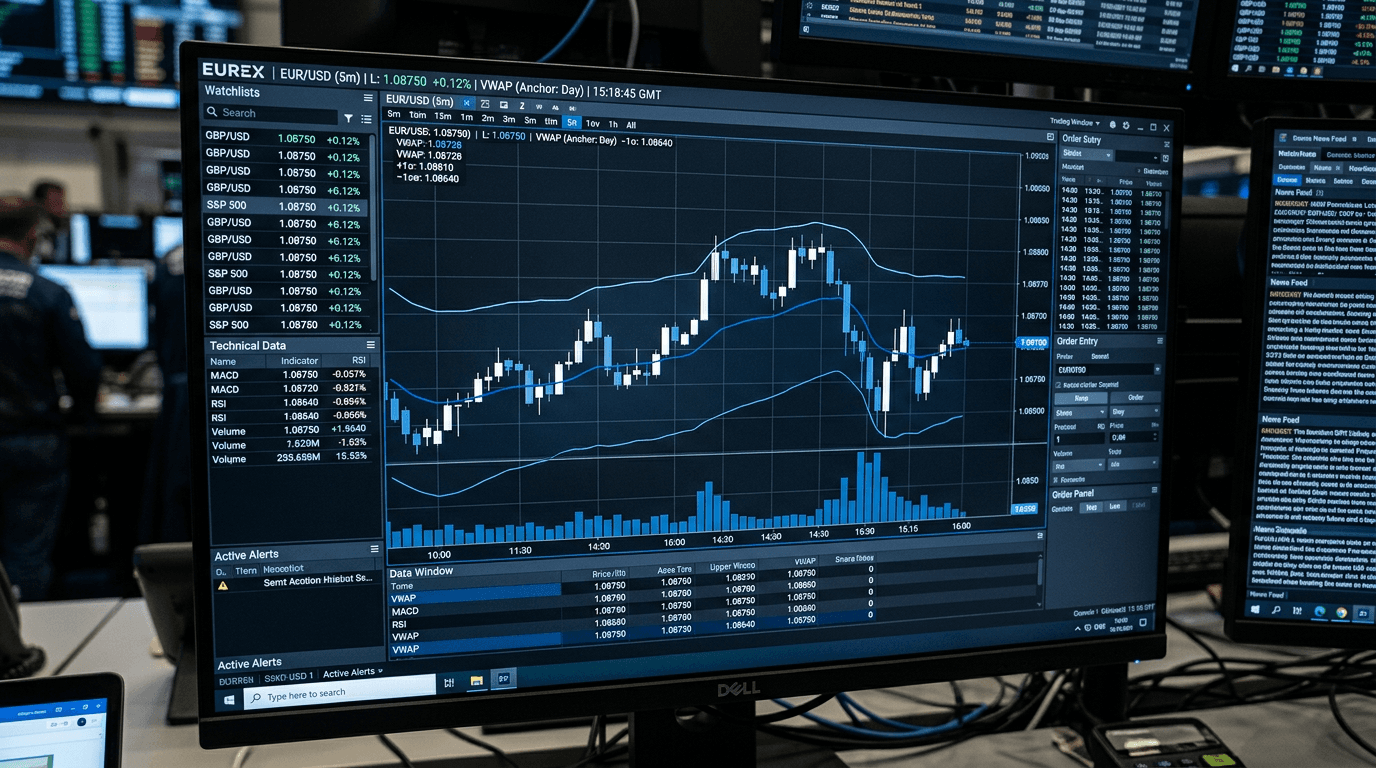
VWAP Trading Strategy: Complete Guide for Active Traders

What VWAP Is and Why Institutions Care About It

VWAP is defined as the cumulative dollar volume traded divided by the cumulative share volume traded from market open to the current moment. Unlike a simple moving average that weights each price equally, VWAP weights prices by how much volume traded at each level — making high-volume price levels disproportionately influential. The formula resets each day at market open, which is why VWAP is strictly an intraday indicator. For institutions, VWAP serves as a performance benchmark: if a buy order executes above VWAP, the desk paid more than the average market participant that day — a cost they are accountable for. This accountability creates predictable institutional behavior around VWAP that retail traders can exploit.

  • VWAP resets at market open every session — it is strictly intraday
  • High-volume periods (open, news events) pull VWAP more than low-volume periods
  • Institutions benchmark execution quality against VWAP — creating predictable price behavior
  • VWAP acts as a dynamic support/resistance level because large players defend it
  • Price above VWAP = buyers winning the day; below VWAP = sellers winning

VWAP as Dynamic Support and Resistance

The most useful property of VWAP for retail traders is its function as dynamic support and resistance. When price is trending above VWAP, it acts as support — institutions with unfilled buy orders at VWAP will defend it, because buying at VWAP means beating their benchmark. When price is trending below VWAP, it acts as resistance — sellers defend VWAP for the same reason. The reliability of VWAP as support/resistance is directly proportional to trend strength. In a strong uptrend, price rarely closes more than 1 standard deviation from VWAP, and each touch of VWAP is a legitimate long entry. In choppy or reversing conditions, VWAP loses its directional bias and becomes a magnet rather than a floor — price oscillates through it without sustained follow-through.

  • In strong trends: VWAP acts as support (uptrend) or resistance (downtrend)
  • In choppy markets: VWAP becomes a mean-reversion target rather than a trend tool
  • First touch of VWAP after a trend move often produces the highest-quality entry
  • Multiple rapid crosses of VWAP signal a choppy, no-trade condition
  • VWAP + standard deviation bands (VWAP bands) define extreme overextension zones

Three High-Probability VWAP Trading Setups

Setup 1 — VWAP Pullback (trend continuation): After a strong open above VWAP with expanding volume, wait for price to pull back to VWAP with contracting volume, then enter long as price bounces off VWAP with a stop below the VWAP low. This is the highest-probability VWAP trade and the preferred setup of most professional day traders. Setup 2 — VWAP Reclaim (reversal): When price dips below VWAP, creates a lower low, then reclaims VWAP with a volume spike, this signals a failed breakdown and often leads to a rapid squeeze toward the day's high. Stop goes below the failed breakdown low. Setup 3 — VWAP Fade (mean reversion): When price extends 2+ standard deviations above VWAP with volume exhaustion, short the extension targeting a return to VWAP. This is the lowest-probability setup and only appropriate in confirmed choppy conditions — never fade VWAP extensions in a trending market.

  • VWAP pullback: strongest setup in trending markets, long at VWAP bounce
  • VWAP reclaim: failed breakdown signal, enter on reclaim with volume confirmation
  • VWAP fade: mean-reversion play at extreme extensions, only in choppy markets
  • Always confirm with volume: high volume on trend moves, low volume on pullbacks
  • Never take VWAP pullback longs if price has crossed VWAP 3+ times already

Combining VWAP with the Opening Range

VWAP alone is a powerful tool, but combining it with the opening range (the high/low established in the first 5, 15, or 30 minutes) creates a two-factor filter that dramatically improves trade quality. The optimal condition is alignment: price above both VWAP and opening range high is the strongest bullish signal — institutions are winning the day and the market has confirmed directional bias. The weakest trade condition is when price is above opening range high but below VWAP, or vice versa — these mixed signals indicate institutional indecision and should be avoided. The most experienced VWAP traders only take trades when VWAP, opening range, and price action direction are all in agreement.

  • Price above VWAP + above opening range high = strongest bullish alignment
  • Price below VWAP + below opening range low = strongest bearish alignment
  • Mixed signals (above one, below other) = no-trade condition for beginners
  • Opening range breakout above VWAP with volume surge = highest-probability long
  • VWAP acts as the 'tie-breaker' when opening range breakout signal is ambiguous

Common VWAP Trading Mistakes to Avoid

The most common VWAP mistake is treating it as a buy-on-touch indicator regardless of market context. In strong trending markets, touching VWAP is a gift — a cheap re-entry. In choppy markets, touching VWAP means nothing — it will be crossed again in minutes. Before taking any VWAP trade, determine whether the market is trending or choppy. If price has crossed VWAP more than two times in the first hour, you are in a choppy environment — switch to a mean-reversion framework or stand aside. The second major mistake is ignoring time of day. VWAP is most reliable in the first two hours (9:30–11:30 AM ET) and the last hour (3:00–4:00 PM ET). Midday trades between 11:30 AM and 2:00 PM have lower volume and less institutional participation — VWAP setups during this window have significantly lower reliability.

  • Never buy VWAP blindly — confirm trending vs. choppy conditions first
  • 3+ VWAP crosses in the first hour = choppy day, change strategy or sit out
  • Best VWAP trading hours: 9:30–11:30 AM ET and 3:00–4:00 PM ET
  • Midday VWAP (11:30 AM–2:00 PM) has lower volume and lower reliability
  • Track your VWAP trades by market condition — separate trending-day stats from choppy-day stats

Related Resources

FAQ

?What is VWAP and how is it calculated?

VWAP stands for Volume Weighted Average Price. It is calculated by dividing the cumulative dollar volume traded (price × shares) by the cumulative total shares traded from market open to the current moment. Because it weights prices by volume, high-volume periods have more influence on VWAP than low-volume periods. VWAP resets at market open each session.

?Is VWAP better than moving averages for day trading?

For intraday trading, VWAP is generally superior to simple moving averages because it incorporates volume — telling you not just where price has been, but at what volume-weighted price. Moving averages treat all periods equally regardless of how much activity occurred. However, VWAP only works intraday (it resets daily), while moving averages can be used across any timeframe.

?How do institutions use VWAP?

Institutions use VWAP primarily as an execution benchmark. A buy order that fills above VWAP is 'worse than the market' — the trader paid more than the average participant that day. This creates accountability pressure that leads institutions to defend VWAP as support (when bullish) or resistance (when bearish), making it a self-fulfilling technical level due to the sheer size of institutional participation.

?What is the best VWAP trading strategy for beginners?

The VWAP pullback setup is the most beginner-friendly VWAP strategy. Wait for price to trend strongly above VWAP in the first hour with expanding volume. Then wait for a pullback to VWAP on contracting volume. Enter long as price bounces off VWAP with a stop below the VWAP low. This setup has clear, defined parameters and works well in trending markets.

Track Your VWAP Trades and Find Your Real Edge

Tiltless logs every VWAP setup you trade — pullbacks, reclaims, fades — and shows you your actual win rate by setup type and market condition. After 50 trades, you know exactly which VWAP setups you execute well and which ones you don't.

VWAP Trading Strategy: Complete Guide | Tiltless