
Updated: 2026-03-08

Bollinger Bands Trading: How to Actually Use Them (Not Just Display Them)

John Bollinger introduced Bollinger Bands in the 1980s, and they remain one of the most widely displayed — and most widely misunderstood — indicators in trading. The core concept is elegant: a moving average flanked by two bands set at a multiple of standard deviation. When volatility rises, the bands widen. When volatility contracts, the bands squeeze. Yet the majority of traders use Bollinger Bands as simple buy/sell triggers — buy the lower band, sell the upper band — a mechanical application that ignores everything the creator actually documented about how the bands work. A 2019 study published in the International Review of Financial Analysis examined 17 technical indicators across 16 markets and found Bollinger Band strategies significantly outperformed buy-and-hold only when applied with volume confirmation and trend context — not as standalone mean-reversion triggers. This guide explains how Bollinger Bands work structurally, which setups have documented edge, and how to build a trading journal system that measures your actual Bollinger Band performance rather than assumed performance.
Track your patterns free →No credit card · Free forever
Bollinger Bands Trading: How to Actually Use Them (Not Just Display Them)

How Bollinger Bands Actually Work

Bollinger Bands consist of three lines: a middle band (default: 20-period simple moving average), an upper band (middle + 2 standard deviations), and a lower band (middle − 2 standard deviations). By definition, approximately 90% of price action falls within the bands when the underlying distribution is roughly normal. The bands are not static — they expand when volatility increases and contract when volatility decreases. This is where most traders get confused: touching or crossing a band is not a signal in isolation. It is information about where price is relative to recent statistical ranges.

Bollinger himself explicitly warned against treating band touches as buy/sell signals without confirmation. The bands define relative high and low — not absolute overbought and oversold. In a strong trend, price can walk along the upper or lower band for extended periods. A mechanical system that buys every lower-band touch in a downtrend is fading trending behavior with no structural edge. The correct framing: Bollinger Bands define the volatility envelope. What price does at the envelope determines the trade setup — not the envelope touch itself.

  • Middle band: 20-period SMA (the baseline trend reference)
  • Upper/lower bands: ±2 standard deviations — statistically, ~90% of price falls inside
  • Bands expand in high-volatility environments, contract in low-volatility environments
  • Band touch = volatility context, NOT a buy or sell signal in isolation
  • Price can walk along a band for extended periods during strong trends
  • Confirmation from volume, price action, or momentum is required before acting on band touches

The Bollinger Squeeze: The Setup That Actually Works

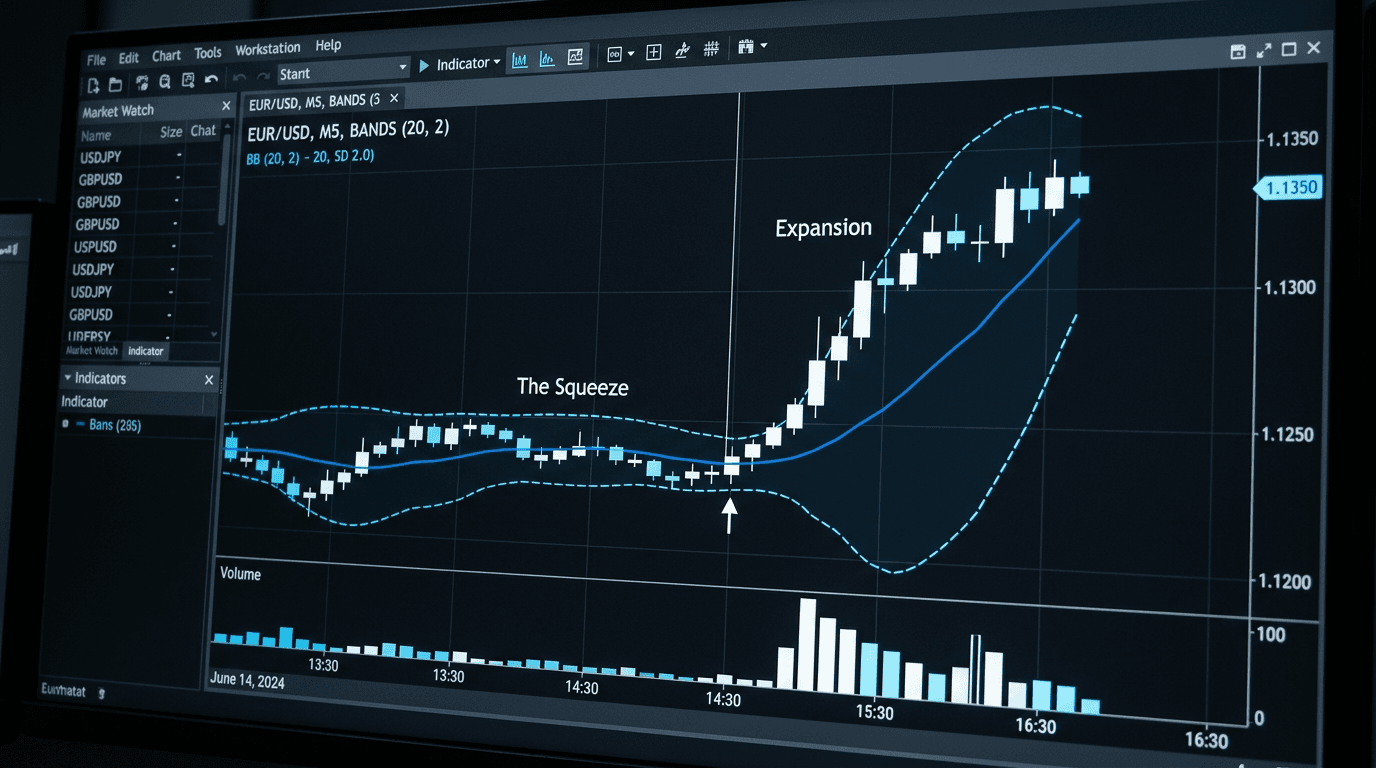
The Bollinger Squeeze is arguably the most documented and historically reliable Bollinger Band setup. A squeeze occurs when the bands contract to their narrowest point in a defined lookback period — typically measured by the bandwidth indicator (upper band minus lower band, divided by the middle band). Narrow bandwidth signals a period of low volatility and price compression that statistically precedes a significant directional move. The logic: markets alternate between compression and expansion. A period of unusually low volatility — a coil — eventually releases in a breakout.

The squeeze itself does not tell you direction. That is the setup; the signal is the expansion. Traders monitor for: (1) bandwidth compressing to multi-month lows, (2) a momentum indicator (TTM Squeeze, Keltner Channel relationship, or rate of change) shifting from negative to positive or vice versa, and (3) a candle closing outside the bands as confirmation. False squeezes — where bands briefly tighten and then reverse without a meaningful move — are common in choppy, low-liquidity environments. The filter: a squeeze with declining average true range and tightening Keltner Channels simultaneously has a higher completion rate than a squeeze in band compression alone.

  • Bollinger Squeeze: bands at their narrowest point in recent history (measure with bandwidth)
  • Squeeze signals low volatility compression — statistically precedes directional expansion
  • Squeeze alone does not give direction — wait for momentum confirmation before entering
  • Confirmation: bandwidth expanding + candle closing outside bands + volume surge
  • Filter: Keltner Channels inside Bollinger Bands simultaneously = higher-confidence squeeze
  • Avoid squeeze setups during major news events — volatility can spike in either direction

Mean Reversion vs. Trend-Following With Bollinger Bands

Bollinger Bands support two fundamentally different trading approaches — and using the wrong one for the market regime is the most common cause of Bollinger Band losses. In ranging, low-trending markets, the mean-reversion approach works: fade band touches with confirmation, target the middle band, and exit if price closes outside the band you faded. In trending markets, price walks along the outer band, and fading it is capital destruction. Bollinger himself documented the 'W-bottom' setup — a mean reversion pattern where price tests the lower band, bounces, and then retests the lower band without making a new low before recovering. The non-confirmation on the second test is the key. The 'M-top' is the bearish equivalent. Both patterns require a momentum divergence on the retest — not just a double touch.

For trend-following, the applicable setups are continuation patterns: price breaks above the upper band on a squeeze expansion, pulls back to the middle band (20 SMA), and then bounces — this is a continuation entry in an expanding trend. Similarly, a Bollinger Band walk (multiple closes above the upper band) signals trend strength, not an overbought condition to fade.

  • Mean reversion works in ranging markets — fails in trending markets
  • W-bottom: lower band test → bounce → retest without new low → recovery confirmation
  • M-top: upper band test → drop → retest without new high → breakdown confirmation
  • Both W-bottom and M-top require momentum divergence on the retest to be valid
  • Trend-following: enter on pullbacks to middle band after upper-band squeeze breakout
  • Band walk (multiple closes outside band) = trend strength, NOT overbought signal to fade

Track Your Bollinger Band Setups and Find Your Actual Edge

Log each Bollinger trade with setup type, middle band slope, bandwidth, and %b. Tiltless calculates your win rate by setup type so you know which Bollinger setups actually work for you — and which don't.

Start Tracking Bollinger Trades — Free

%b and Bandwidth: The Indicators Bollinger Actually Recommended

John Bollinger documented two derived indicators from the bands that most traders ignore: %b (percent b) and Bandwidth. %b measures where price is relative to the bands on a scale of 0 to 1. A %b of 1.0 means price is at the upper band. A %b of 0 means price is at the lower band. A %b above 1.0 means price has closed outside the upper band; below 0 means price is outside the lower band. %b is more useful than a raw band touch because it quantifies the degree of penetration — a %b of 1.2 is a much stronger upper band breach than a %b of 1.02.

Bandwidth measures the width of the bands relative to the middle band: (upper − lower) / middle × 100. Low Bandwidth = low volatility (potential squeeze forming). High Bandwidth = high volatility (expansion phase). Bollinger noted that new lows in Bandwidth after an extended period of high Bandwidth often precede significant directional moves. Tracking both %b and Bandwidth on a separate panel transforms the visual bands into quantifiable data points you can log in a journal and analyze statistically.

  • %b measures price position relative to bands (0 = lower band, 1.0 = upper band, >1 = outside upper)
  • Use %b to quantify band penetration — not just whether price touched the band
  • Bandwidth = (upper − lower) / middle × 100 — measures volatility envelope width
  • Low Bandwidth after extended high Bandwidth precedes directional moves (Bollinger's documented rule)
  • Both indicators convert visual band information into numerical data for journaling
  • Log %b at entry and exit for each Bollinger trade to quantify your setups statistically

The Most Damaging Bollinger Band Mistakes

The most expensive mistake: mechanically fading every lower band touch in a downtrend. In a strong downtrend, price repeatedly approaches and touches the lower band — and closes below it on breakdowns. Buying every lower band touch without trend context is fading momentum with negative expectancy. The fix: always check the slope and position of the middle band (20 SMA) first. If the middle band is sloping sharply downward, you are in a downtrend. Only take long mean-reversion setups from the lower band when the middle band is flat or sloping upward.

The second mistake: confusing the Bollinger Squeeze with an imminent breakout. The squeeze identifies a state — low volatility compression — but does not guarantee timing. Squeezes can persist for weeks. Entering too early means sitting in a dead trade while capital is tied up. The discipline: wait for the expansion signal, not the squeeze formation.

The third mistake: not adjusting the standard deviation multiplier for the asset or timeframe. The default 2.0 SD works well for daily equity charts. For highly volatile assets (crypto) or shorter timeframes (5-minute), a 2.5 SD multiplier reduces false signals at the expense of fewer, cleaner setups. The multiplier is a calibration variable, not a constant.

  • Never fade lower band touches in a downtrend — check middle band slope first
  • Only mean-revert from lower band when 20 SMA is flat or rising
  • Do not enter on the squeeze formation itself — wait for expansion confirmation
  • Squeezes can persist for weeks — patience is required
  • Adjust SD multiplier for asset volatility (2.5 SD for crypto or short timeframes)
  • Log middle band slope at entry — it's the most predictive filter for mean reversion setups

How to Journal Bollinger Band Trades for Edge

Bollinger Band setups have measurable, repeatable inputs — which makes them well-suited for systematic journaling and edge validation. For each Bollinger trade, log: the setup type (squeeze breakout, W-bottom, M-top, band walk continuation, mean reversion), the middle band slope (uptrend, downtrend, flat), the bandwidth reading at entry (compression vs. expansion phase), the %b at entry, the volume confirmation (yes/no), and the outcome (target hit, stopped, exited manually).

After 30–50 trades across a setup type, analyze which combinations produce your best results. Most traders discover their Bollinger edge is highly specific: for example, W-bottoms with rising middle band + declining volume on the retest + %b between 0 and 0.1 might have a 65%+ win rate in their instruments, while mechanical lower-band fades have negative expectancy. This kind of granular analysis is only possible with systematic logging — a trading journal that captures setup context, not just entry and exit prices.

  • Log setup type: squeeze breakout, W-bottom, M-top, band walk, mean reversion
  • Record middle band slope at entry — the single most important filter
  • Note bandwidth reading: was this entry during compression or expansion?
  • Record %b at entry and exit to quantify band penetration
  • Track volume confirmation — did volume confirm or fail to confirm the signal?
  • After 30+ trades, filter by setup type and trend context to find your actual edge

Related Resources

FAQ

?What are Bollinger Bands in trading?

Bollinger Bands are a volatility indicator consisting of three lines: a 20-period simple moving average in the middle, with upper and lower bands set at 2 standard deviations above and below the average. Approximately 90% of price action falls within the bands under normal market conditions. The bands expand during high-volatility periods and contract during low-volatility periods, making them useful for identifying volatility squeezes and breakouts.

?How do you trade Bollinger Bands effectively?

Effective Bollinger Band trading requires context. In ranging markets, trade mean reversion setups like the W-bottom (lower band retest without a new low) or M-top (upper band retest without a new high), targeting the middle band. In trending markets, look for squeeze breakouts — bands at multi-period lows followed by a directional expansion. Always confirm with volume and check the middle band slope. Never mechanically fade every band touch without trend context.

?What is the Bollinger Band squeeze?

The Bollinger Band squeeze occurs when the bands contract to their narrowest point in a defined lookback period, indicating unusually low volatility. A squeeze signals market compression that statistically precedes a significant directional move. The squeeze itself does not provide direction — you wait for an expansion signal: bandwidth expanding, a momentum indicator turning, and ideally a candle closing outside the bands with volume. False squeezes are common; adding Keltner Channels as a filter improves reliability.

?What timeframe works best for Bollinger Bands?

Bollinger Bands work across timeframes, but the default 20-period, 2 standard deviation settings are calibrated for daily charts. On shorter timeframes (5-minute, 15-minute), consider widening the standard deviation to 2.5 to reduce noise. On weekly charts, the default settings work well for identifying major squeeze setups. Intraday Bollinger Band trading tends to produce more false signals and requires stricter volume and momentum confirmation than daily or weekly setups.

Track Your Bollinger Band Setups and Find Your Actual Edge

Log each Bollinger trade with setup type, middle band slope, bandwidth, and %b. Tiltless calculates your win rate by setup type so you know which Bollinger setups actually work for you — and which don't.

Bollinger Bands Trading Strategy: Complete Guide