
Updated: 2026-03-08

Elliott Wave Trading: Pattern Recognition Guide

Elliott Wave Theory — defined as a form of technical analysis that identifies recurring fractal wave patterns in financial markets, alternating between five-wave impulse moves and three-wave corrective moves — was developed by accountant Ralph Nelson Elliott in the 1930s after analyzing 75 years of stock market data. According to a 2018 meta-analysis of Elliott Wave studies published in the International Review of Financial Analysis, Elliott Wave analysis demonstrated statistically significant forecasting ability in equity markets when applied by trained practitioners, with the most reliable signals occurring in Wave 3 entries during confirmed impulse sequences. While Elliott Wave is often dismissed as subjective, traders who learn its core rules and use it alongside Fibonacci ratios develop a systematic framework for identifying where price is in its cycle — and positioning accordingly.
Track your patterns free →No credit card · Free forever
Elliott Wave Trading: Pattern Recognition Guide

Impulse Waves: The Five-Wave Motive Structure

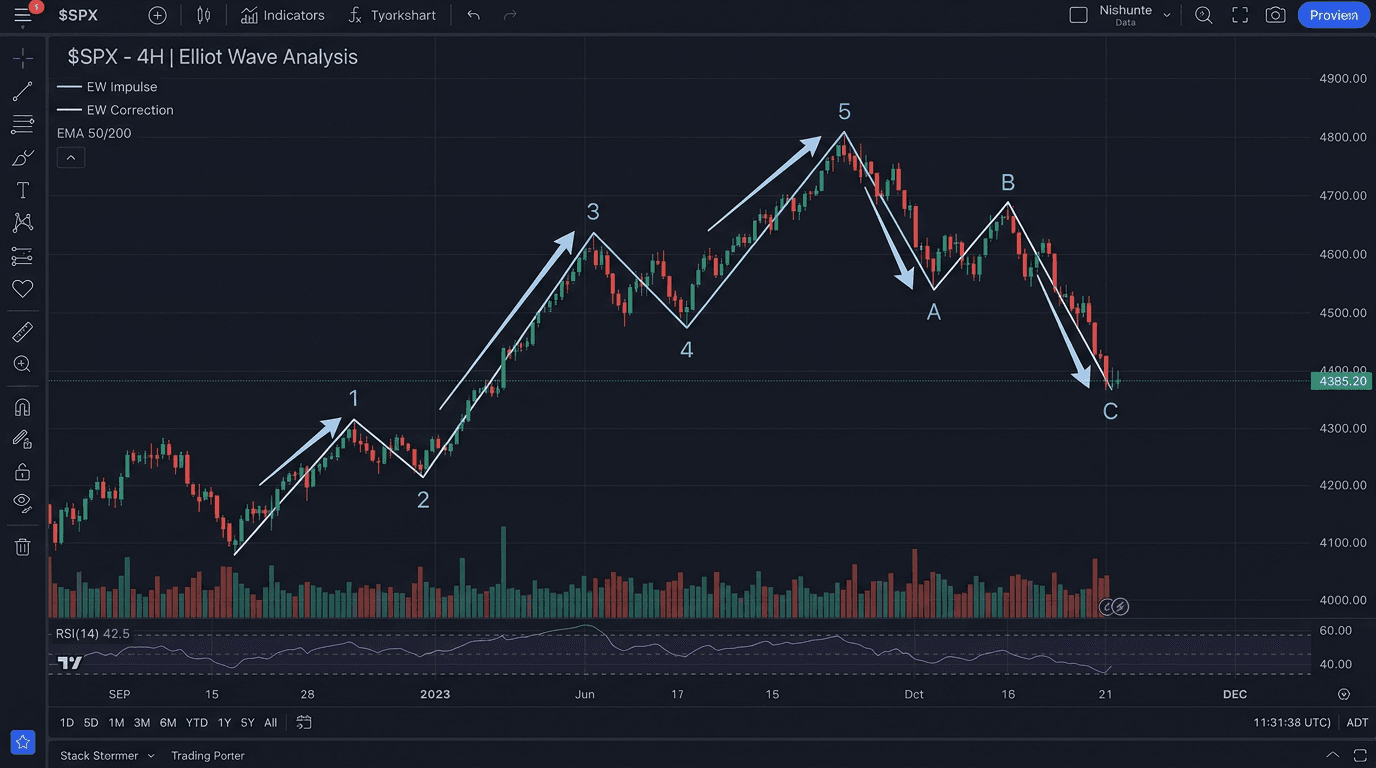
The foundation of Elliott Wave is the impulse wave — a five-wave sequence that moves in the direction of the larger trend. Waves 1, 3, and 5 are motive waves (moving with the trend); Waves 2 and 4 are corrective waves (moving against the trend). Three rules define a valid impulse wave and cannot be broken. Rule 1: Wave 2 never retraces more than 100% of Wave 1. If it does, the pattern is not a valid impulse. Rule 2: Wave 3 is never the shortest motive wave. It can equal Wave 1 or 5, but never be shorter than both. Rule 3: Wave 4 never overlaps Wave 1 territory (except in rare diagonal triangle formations). These rules give Elliott Wave its power — they eliminate many otherwise plausible wave counts, narrowing the field of valid interpretations. Among the motive waves, Wave 3 is the most important. It is typically the longest and strongest, driven by expanding volume and momentum. Wave 3 entries — buying as Wave 2 completes and Wave 3 begins — are the highest-probability, highest-return Elliott setups.

  • Impulse = 5 waves: 1-2-3-4-5 (motive-corrective-motive-corrective-motive)
  • Rule 1: Wave 2 cannot retrace more than 100% of Wave 1
  • Rule 2: Wave 3 is never the shortest motive wave (1, 3, or 5)
  • Rule 3: Wave 4 cannot enter Wave 1 territory (except diagonal triangles)
  • Wave 3 is usually the longest, strongest wave — the best trade setup
  • Volume typically expands through Wave 3 and contracts in Wave 4

Corrective Wave Patterns: ABC Structures

After a five-wave impulse completes, price corrects in a three-wave pattern labeled A-B-C before the larger trend resumes. The most common corrective structure is the Zigzag — a sharp three-wave correction where Wave A and C are impulse-like moves and Wave B is a brief bounce. Zigzags typically retrace 50–78.6% of the prior impulse. The Flat correction is shallower — Wave B retraces most of Wave A, and Wave C ends near the start of Wave A, creating a sideways consolidation. The Triangle is a five-wave horizontal structure (A-B-C-D-E) that typically forms as Wave 4 of an impulse. A completed triangle almost always precedes the final Wave 5 move — making it a useful anticipatory signal. For traders, the critical skill is identifying the end of the C wave (or the end of a complex corrective structure) because that marks the beginning of the next impulse. The C wave often ends at or near a Fibonacci extension of Wave A, providing a specific price zone to watch for reversal signals.

  • Zigzag (5-3-5): sharp correction, retraces 50–78.6% of prior impulse
  • Flat (3-3-5): shallow, sideways correction; Wave B retraces most of Wave A
  • Triangle (3-3-3-3-3): five sideways waves, usually forms as Wave 4
  • Triangle breakout (Wave 5 launch) is one of Elliott's most reliable setups
  • C wave end = best entry for the next impulse in trend direction
  • Wave C often terminates at Fibonacci extension of Wave A (100%, 127.2%, or 161.8%)

Fibonacci Relationships in Elliott Wave

Elliott Wave and Fibonacci ratios are inseparable — the wave structure is fundamentally governed by the Fibonacci sequence. Wave 2 typically retraces 50%, 61.8%, or 78.6% of Wave 1. Wave 3 typically extends 161.8% of Wave 1 (the most common extension) or 261.8% in extended third waves. Wave 4 retraces 38.2% or 50% of Wave 3. Wave 5 is often equal to Wave 1 (100% relationship) or 61.8% of Waves 1 through 3 combined. For corrective waves, Wave C is often equal to Wave A (100%) or 61.8%/161.8% of Wave A. These relationships let traders project specific price targets for each wave — not ranges, but precise levels where wave termination is likely. The professional approach: after identifying the current wave count, calculate the Fibonacci confluence zone where multiple projections cluster. A zone where Wave 3's 161.8% extension, a prior support/resistance level, and the daily Kijun-sen all converge is a high-probability reversal or continuation point. Single Fibonacci levels mean less than clusters of multiple independent measurements pointing to the same zone.

  • Wave 2: typically retraces 50%, 61.8%, or 78.6% of Wave 1
  • Wave 3: most commonly extends 161.8% of Wave 1 (extended waves reach 261.8%)
  • Wave 4: typically retraces 38.2% or 50% of Wave 3
  • Wave 5: often equals Wave 1 or 61.8% of waves 1+2+3
  • Wave C: most commonly equals Wave A (100%) or extends 161.8% of A
  • Look for Fibonacci confluence — multiple projections pointing to the same zone

Journal Your Elliott Wave Counts and Find Your Real Edge

Log which wave type you're trading, your Fibonacci entry level, and higher-timeframe alignment. Tiltless shows you your actual win rate by Elliott Wave setup — so you know which patterns you execute well and which to avoid.

Start Tracking Elliott Wave Trades — Free

How to Count Waves in Practice

Wave counting is the practical challenge of Elliott Wave — and where most traders go wrong. The key principle: start with the highest timeframe and work down. On a weekly chart, identify the largest visible impulse sequence. Then zoom to the daily chart to see the sub-waves within that structure. Then to the 4-hour chart for entry timing. This top-down approach prevents the common mistake of counting micro-waves and missing the dominant macro structure. A second principle: label what is certain first, leave ambiguous waves as alternatives. Every wave count should have a primary count (most likely interpretation) and an alternate count (second-most likely). The alternate count tells you exactly what would invalidate your primary count — giving you an automatic stop-loss level. Third: always track the three rules. Any count that violates Rule 1 (Wave 2 > 100% of Wave 1), Rule 2 (Wave 3 shortest), or Rule 3 (Wave 4 overlaps Wave 1) is automatically invalid — eliminate it. This process of elimination, not guessing, is how accurate Elliott Wave analysis works.

  • Start on the highest timeframe — identify macro structure first
  • Work down: weekly → daily → 4H for entry timing
  • Maintain a primary count and an alternate count simultaneously
  • Alternate count = automatic invalidation level = your stop loss
  • Apply the three rules as filters — eliminate invalid counts immediately
  • Never force a wave count to fit — if it violates rules, it is wrong

How to Trade Elliott Wave Setups

The three highest-probability Elliott Wave trade setups are: Wave 3 entries, Wave 5 completions (reversal trades), and Wave C completions (trend resumption entries). For Wave 3 entries: after a completed Wave 1 and a Wave 2 retracement to the 61.8% Fibonacci level, buy (or short) with a stop below Wave 1's start. The Wave 3 target is initially 161.8% of Wave 1 from Wave 1's low. For Wave C completions: after a full five-wave impulse, wait for the A-B-C correction to complete. Wave C often terminates at the 61.8% retracement of the prior five-wave move or at the 100% extension of Wave A. Enter in the direction of the prior impulse with a stop below the Wave C low. The target is a new impulse equal to or exceeding the prior five-wave move. For Wave 5 completions (counter-trend): when Wave 5 appears near the 61.8% extension of Waves 1 through 3, watch for reversal signals — bearish divergence on RSI, a failed breakout, or a reversal candlestick. These setups require tighter stops and smaller positions because you are fading momentum.

  • Best trade: Wave 3 entry after Wave 2 retraces to 61.8% of Wave 1
  • Wave 3 stop: below Wave 1's start (any violation = invalid impulse)
  • Wave 3 target: 161.8% extension of Wave 1 from Wave 1's low
  • Wave C completion: buy (or short) with stop below Wave C low
  • Wave 5 reversal: smaller position, tighter stop, wait for divergence + candle confirmation
  • Always verify your entry against the larger wave count on higher timeframes

Tracking Elliott Wave Trades in a Journal

Elliott Wave analysis is difficult to backtest because wave labeling is subjective — which makes journaling even more important. For each Elliott Wave trade, log: the wave you're trading (2 completion entry, 3 extension, 4 completion, 5 completion, or C completion), your primary wave count at entry, the Fibonacci level where you entered, whether all three impulse rules were satisfied, and whether the higher timeframe wave count aligned. After 40+ trades, filter by wave type. Most Elliott Wave traders discover they have genuine edge in Wave 3 entries from confirmed Wave 2 lows (strong Fibonacci confluence, clean impulse structure) but lose money on Wave 5 counter-trend reversals where they guess the top. Journaling reveals this pattern in your own data, giving you the evidence to focus on high-edge setups and stop taking speculative counter-trend trades.

  • Log: which wave you're trading, primary count at entry, Fibonacci entry level
  • Record whether all three impulse rules were verified at entry
  • Track higher timeframe wave count — aligned vs misaligned with trade direction
  • After 40+ trades, filter by wave type to find your actual edge
  • Most traders have edge in Wave 3 entries but lose on Wave 5 counter-trend bets
  • Let your trade journal data eliminate low-edge setups — not ego or theory

Related Resources

FAQ

?What is Elliott Wave Theory in trading?

Elliott Wave Theory is a form of technical analysis developed by Ralph Nelson Elliott in the 1930s, proposing that financial markets move in predictable, recurring wave patterns driven by crowd psychology. The theory identifies five-wave impulse sequences that move with the dominant trend, alternating with three-wave corrective sequences that move against it. These waves are fractal — the same pattern repeats across all timeframes from tick charts to monthly charts.

?What are the three rules of Elliott Wave?

The three unbreakable rules of Elliott Wave are: (1) Wave 2 can never retrace more than 100% of Wave 1 — if it does, the pattern is not a valid impulse; (2) Wave 3 is never the shortest motive wave among Waves 1, 3, and 5; (3) Wave 4 can never overlap the price territory of Wave 1 (with a narrow exception for diagonal triangle formations). Any wave count that violates these rules is immediately invalid and must be discarded.

?What is the best wave to trade in Elliott Wave Theory?

The best wave to trade is Wave 3 — it is typically the longest, most powerful wave in an impulse sequence, driven by expanding volume and momentum. The entry setup: wait for Wave 1 to complete, allow Wave 2 to retrace (commonly to the 61.8% Fibonacci level of Wave 1), then enter in the original direction when Wave 2 shows reversal signals. The stop goes below Wave 1's starting point, and the initial target is the 161.8% Fibonacci extension of Wave 1.

?How do Elliott Waves and Fibonacci relate?

Elliott Wave structures are governed by Fibonacci ratios. Wave 2 typically retraces 50%, 61.8%, or 78.6% of Wave 1. Wave 3 most commonly extends 161.8% of Wave 1. Wave 4 retraces 38.2%–50% of Wave 3. Wave 5 is often equal to Wave 1. These relationships are not coincidences — Elliott himself observed that wave proportions consistently reflected the Fibonacci sequence found in natural growth patterns. Fibonacci confluence zones (where multiple independent projections cluster) are the most reliable reversal and target levels.

Journal Your Elliott Wave Counts and Find Your Real Edge

Log which wave type you're trading, your Fibonacci entry level, and higher-timeframe alignment. Tiltless shows you your actual win rate by Elliott Wave setup — so you know which patterns you execute well and which to avoid.

Elliott Wave Trading: Pattern Recognition Guide | Tiltless