
Updated: 2026-03-08

Ichimoku Cloud Trading: Complete Strategy Guide

Ichimoku Cloud trading — defined as a comprehensive technical analysis system that displays trend direction, momentum, and support/resistance levels simultaneously on a single chart — was developed by Japanese journalist Goichi Hosoda over three decades of research before its 1968 publication. According to a 2020 study published in the International Journal of Financial Studies analyzing Ichimoku signals across major currency pairs, the full Ichimoku system produced statistically significant returns in trending markets with a win rate exceeding 60% when cloud, momentum, and lagging line signals aligned — outperforming simple moving average crossover systems. Unlike indicator-heavy approaches that layer multiple tools on the same data, Ichimoku integrates price action, time, and momentum into five lines that paint a complete picture of market structure at a glance.
Track your patterns free →No credit card · Free forever
Ichimoku Cloud Trading: Complete Strategy Guide

The Five Ichimoku Components Explained

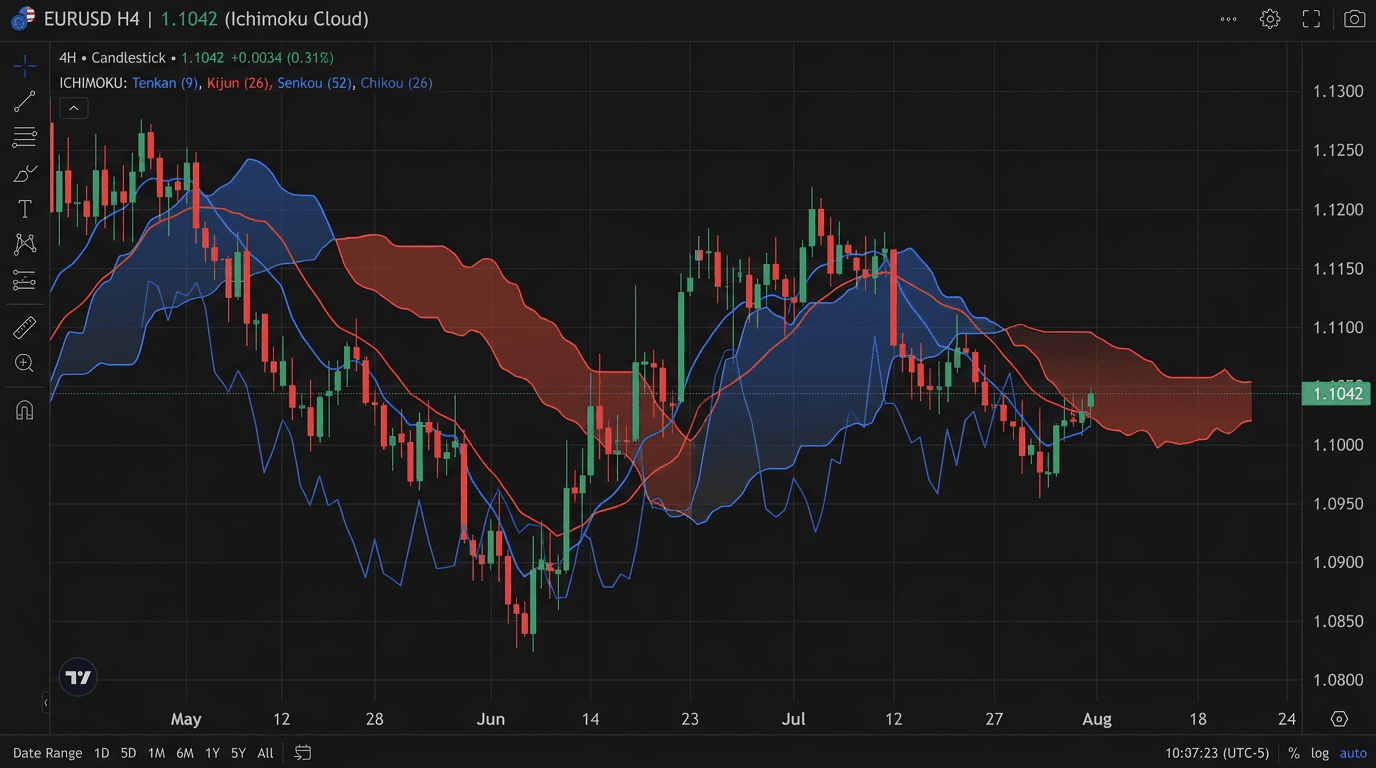
Ichimoku consists of five lines and one cloud formed by two of them. The Tenkan-sen (Conversion Line) is the midpoint of the highest high and lowest low over the last 9 periods — it acts as a fast signal line similar to a short-term moving average. The Kijun-sen (Base Line) is the same calculation over 26 periods — it is the primary trend indicator and acts as dynamic support/resistance. Senkou Span A is the average of Tenkan-sen and Kijun-sen, plotted 26 periods ahead. Senkou Span B is the midpoint of the 52-period high-low range, also plotted 26 periods ahead. Together, Senkou Span A and B form the Kumo (cloud), which is the most visually distinctive element. The space between them is shaded — typically green when Span A is above Span B (bullish cloud) and red when Span B is above Span A (bearish cloud). Finally, the Chikou Span (Lagging Line) is the current closing price plotted 26 periods back — it confirms signals by showing whether price is above or below its own history.

  • Tenkan-sen (9-period midpoint) — fast signal line, short-term momentum
  • Kijun-sen (26-period midpoint) — trend baseline, primary support/resistance
  • Senkou Span A (avg of T+K, plotted +26) — leading cloud boundary
  • Senkou Span B (52-period midpoint, plotted +26) — slower cloud boundary
  • Kumo (cloud) — green when A > B (bullish), red when B > A (bearish)
  • Chikou Span (close plotted -26) — lagging confirmation line

Reading the Kumo Cloud for Trend Direction

The Kumo cloud is the backbone of the Ichimoku system and the first thing to assess on any chart. The primary rule is simple: price above the cloud is bullish, price below the cloud is bearish, price inside the cloud is neutral. But the cloud provides more than directional bias — its thickness indicates support/resistance strength. A thick cloud means price will need more force to break through; a thin cloud signals a potential rapid trend change. Cloud color matters too: a green cloud (Span A above Span B) is bullish, a red cloud is bearish. A cloud color change — called a 'Kumo Twist' — signals a potential trend change weeks in advance because the cloud is plotted 26 periods forward. Traders scan for upcoming Kumo Twists as advance warning of potential trend reversals. The optimal Ichimoku trade setup requires price clearly above (or below) the cloud, not fighting through it. Inside-cloud price action is choppy and produces false signals — most professional Ichimoku traders ignore entries when price is within the cloud.

  • Price above cloud = bullish bias; below cloud = bearish bias; inside cloud = avoid
  • Thick cloud = stronger support/resistance; thin cloud = easier breakthrough
  • Green cloud (Span A > B) = bullish structure; red cloud = bearish structure
  • Kumo Twist (cloud color change) = advance warning of trend change
  • Best entries occur when price is cleanly on one side of the cloud
  • Flat Kijun-sen inside a thick cloud = range environment, reduce position size

The Three-Signal Confirmation Method

Ichimoku's power comes from requiring multiple signals to align before entering a trade. Professional Ichimoku traders use a three-signal confirmation framework. Signal 1 — Price position: price must be clearly above the cloud (for longs) or below it (for shorts). This establishes macro trend alignment. Signal 2 — TK Cross: the Tenkan-sen must cross above the Kijun-sen for long entries (a bullish TK Cross) or below it for shorts (a bearish TK Cross). This is the primary entry trigger. Signal 3 — Chikou confirmation: the Chikou Span (current close plotted 26 periods back) must be above price at that historical level (for longs) or below it (for shorts). This confirms the current move has momentum relative to history. When all three signals align, the trade is considered a 'perfect Ichimoku signal.' Partial signals (one or two of three) are lower-conviction setups. Traders experienced with the system may take 2-signal setups but reduce position size by 50% and tighten stops significantly.

  • Signal 1 (trend): price clearly above cloud (long) or below cloud (short)
  • Signal 2 (entry): Tenkan-sen crosses above Kijun-sen (long) or below (short)
  • Signal 3 (confirmation): Chikou Span above price history (long) or below (short)
  • Perfect signal = all 3 aligned = highest-conviction entry
  • 2-signal setups = take with 50% position size and tighter stops
  • Never force entries when cloud is mixed or Chikou is ambiguous

Track Every Ichimoku Trade and Find Your Edge

Log which Ichimoku signal types you execute profitably — perfect 3-signal vs partial, daily cloud aligned vs misaligned — and let Tiltless calculate your real win rate by setup type. Know exactly which configurations to scale.

Start Tracking Ichimoku Trades — Free

Stop Loss Placement and Target Setting with Ichimoku

Ichimoku provides natural stop loss levels that don't require arbitrary ATR multiples or fixed pip distances. For long entries after a bullish TK Cross above the cloud, the initial stop goes below the Kijun-sen (base line) at the time of entry. If price continues higher, the stop trails to the Kijun-sen as it rises. If price pulls back to touch the Kijun-sen and bounces, that's an add-to opportunity — not a stop-out. A close below the Kijun-sen is the first warning; a close below the Kumo cloud is the exit trigger for swing positions. For profit targets, Ichimoku traders use the Kumo Twist levels projected forward — the cloud's upper and lower boundaries at the target date. Alternatively, prior swing highs or key Kijun-sen levels on higher timeframes serve as target zones. Many traders use a two-part exit: take 50% at the first major resistance (prior swing high or cloud boundary on higher timeframe), trail the remaining 50% with the Kijun-sen until it crosses below the Tenkan-sen.

  • Initial stop: below Kijun-sen for longs, above Kijun-sen for shorts
  • Trailing stop: move stop to Kijun-sen as trade progresses
  • Exit trigger: close below Kumo cloud (swing positions) or Kijun-sen cross (aggressive exit)
  • Pullback to Kijun-sen that holds = add-to opportunity, not stop-out
  • First target: prior swing high or Kumo boundary on higher timeframe
  • Trail 50% of position with Kijun-sen until bearish TK Cross forms

Best Markets and Timeframes for Ichimoku Trading

Ichimoku performs best in trending markets with sustained directional moves — it struggles in choppy, range-bound environments where the cloud produces repeated false breakouts. Historically, forex pairs (especially yen pairs like USD/JPY, EUR/JPY where the system was developed), index futures (ES, NQ), and trending crypto assets show the best Ichimoku signal reliability. Highly choppy stocks or low-volume altcoins produce noisy signals that are difficult to trade. For timeframes, the daily and 4-hour charts produce the most reliable signals — the Kumo cloud is meaningful on these timeframes where the 26-period shift equals roughly a month (daily) or 4-day period (4H). Intraday Ichimoku on 1-minute or 5-minute charts is possible but requires looser parameters (some traders use 9/26/52 on 1H and 15m). The key rule: always check the daily Kumo cloud for macro bias before entering positions on lower timeframes. A short setup on the 4H chart that is fighting a strong daily uptrend cloud will fail more often than it works.

  • Best markets: trending forex pairs (yen crosses), index futures, trending crypto
  • Avoid: choppy stocks, low-liquidity assets, range-bound instruments
  • Best timeframes: daily (macro bias) and 4H (entry timing)
  • Daily cloud = macro filter — never fight a thick daily cloud
  • Intraday: use 1H for setup, 15m for entry, always check daily first
  • Standard parameters (9/26/52) work well on most instruments

How to Log and Review Ichimoku Trades

Ichimoku generates objective, verifiable signals — which makes it ideal for systematic trade logging and post-trade analysis. For each Ichimoku trade, log: the cloud color at entry (bullish/bearish), whether it was a perfect 3-signal or partial 2-signal setup, the Chikou Span position (above/below historical price), and the Kijun-sen direction (rising/flat/declining). After 30–50 trades, analyze your journal by setup type. Most traders discover their edge is concentrated in perfect 3-signal setups with a rising daily cloud, while partial signals in choppy markets drag down overall performance. Tiltless lets you tag trades with custom fields for each Ichimoku component, then filters your performance statistics by signal type. This turns Ichimoku from a qualitative 'feels right' system into a quantified edge you can measure, refine, and scale.

  • Log: cloud color, signal count (2 vs 3), Chikou position, Kijun direction
  • Tag the timeframe and whether daily cloud aligned with entry direction
  • After 30+ trades, filter stats by signal type — 3-signal vs 2-signal performance
  • Most traders find perfect signals return 2–3x more than partial signals
  • Track stop placement: Kijun vs cloud — which produces better risk/reward
  • Use trade journal data to cut underperforming setups and scale winning configurations

Related Resources

FAQ

?What is the Ichimoku Cloud in trading?

The Ichimoku Cloud (Ichimoku Kinko Hyo) is a comprehensive technical analysis system developed by Goichi Hosoda that displays trend direction, momentum, and support/resistance simultaneously on one chart. It consists of five lines: Tenkan-sen (9-period midpoint), Kijun-sen (26-period midpoint), Senkou Span A, Senkou Span B, and Chikou Span. The 'cloud' (Kumo) is the shaded area between Senkou Span A and B, plotted 26 periods ahead.

?What are the best settings for Ichimoku Cloud?

The standard Ichimoku settings are 9, 26, and 52 — representing Tenkan-sen, Kijun-sen, and Senkou Span B periods respectively. These settings were designed for the Japanese stock market's 6-day trading week and work well on daily and 4-hour charts for most instruments. Some crypto traders adjust to 10, 30, 60 to account for 24/7 markets, but most professional traders use the standard settings as they represent the most commonly watched levels.

?How do I confirm an Ichimoku buy signal?

A confirmed Ichimoku buy signal requires three conditions: (1) price is above the Kumo cloud, (2) the Tenkan-sen crosses above the Kijun-sen (TK Cross), and (3) the Chikou Span is above price at its historical position 26 periods back. When all three conditions align, this is called a 'perfect signal' and is the highest-conviction Ichimoku buy setup. Fewer signals aligned = lower conviction = smaller position size.

?Is the Ichimoku Cloud better than moving averages?

Ichimoku integrates five data points including a forward-looking cloud, making it more comprehensive than a two-line moving average crossover system. It provides trend direction, momentum, support/resistance, and confirmation signals in one indicator. However, it is more complex to interpret and can generate false signals in choppy, range-bound markets — the same weakness as all trend-following indicators. Most experienced Ichimoku traders use it with price action context rather than mechanically.

Track Every Ichimoku Trade and Find Your Edge

Log which Ichimoku signal types you execute profitably — perfect 3-signal vs partial, daily cloud aligned vs misaligned — and let Tiltless calculate your real win rate by setup type. Know exactly which configurations to scale.

Ichimoku Cloud Trading Strategy: Complete Guide | Tiltless