
Updated: 2026-03-08

Market Structure Trading: How to Identify Trends and Trade Them

Market structure — defined as the pattern of higher highs and higher lows (uptrend), lower highs and lower lows (downtrend), or equal highs and lows (range) that price creates over time — is the most fundamental framework in technical analysis. According to Dow Theory, which Charles Dow developed from his observation of industrial and railroad averages in the late 1800s and which remains validated by modern quantitative research, price trends persist until a specific structural shift signals their end. A 2019 study by Faber examining trend-following across 215 years of global asset prices found that a simple trend-following strategy based on structure outperformed buy-and-hold in 96% of markets tested. Market structure is not a lagging indicator — it is the market itself. Understanding it is the prerequisite for every other form of technical analysis.
Market Structure Trading: How to Identify Trends and Trade Them

The Three Market Structures Every Trader Must Recognize

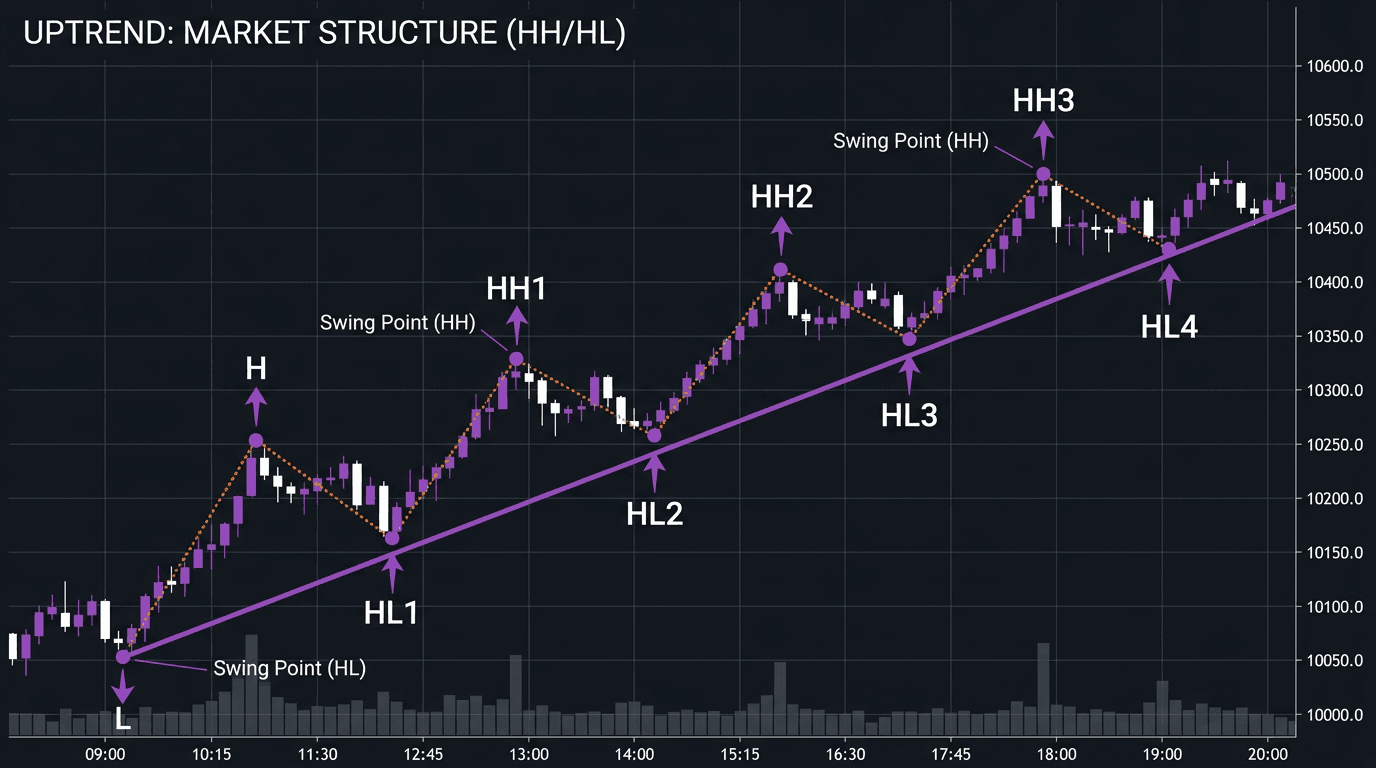
Every market exists in one of three states at any given moment on any given timeframe. Uptrend: defined by higher swing highs (HH) and higher swing lows (HL). Each new rally exceeds the previous peak; each pullback holds above the previous trough. This is the structure where buyers are in control. Downtrend: defined by lower swing highs (LH) and lower swing lows (LL). Each rally fails below the prior peak; each selloff makes a new low. Sellers are in control. Range: price oscillates between a defined support level and resistance level without making new highs or lows. Neither buyers nor sellers have consistent control. The critical skill is correctly identifying which structure you are in — because the correct trading strategy differs dramatically between all three, and trading the wrong strategy for the current structure is a primary cause of repeated losses.

  • Uptrend: higher highs (HH) + higher lows (HL) — buy pullbacks to higher lows
  • Downtrend: lower highs (LH) + lower lows (LL) — sell rallies to lower highs
  • Range: price between defined support and resistance — fade extremes or wait for breakout
  • Structure must be confirmed by at least 2 confirmed swing points in each direction
  • Timeframe matters: a stock can be in an uptrend on the weekly and downtrend on the daily

Break of Structure (BOS): How to Identify Trend Continuation

A break of structure (BOS) occurs when price breaks through a previous swing high (in an uptrend) or a previous swing low (in a downtrend), confirming the trend is continuing and the prior structure remains intact. In an uptrend, each time price breaks the previous higher high, it is making a new higher high — confirming trend continuation. Traders use BOS as permission to add to existing trend positions or as confirmation that a pullback has ended and the trend has resumed. BOS is different from a breakout: a BOS confirms the existing trend structure, while a breakout implies a break from a range or reversal of structure. The distinction matters because BOS-based entries have the highest win rates in trending markets — you are trading with confirmed momentum, not attempting to predict it.

  • Uptrend BOS: price breaks above previous swing high — trend is intact, look to buy
  • Downtrend BOS: price breaks below previous swing low — trend is intact, look to sell
  • BOS confirms trend continuation — use as permission to enter or add to positions
  • Wait for a close above/below the prior swing point for confirmed BOS (not just a wick)
  • BOS on higher timeframes carries more weight than BOS on lower timeframes

Change of Character (CHoCH): The Early Reversal Warning

A change of character (CHoCH) is the first signal that the prevailing trend may be ending. In an uptrend, a CHoCH occurs when price fails to make a new higher high and instead makes a lower high — then breaks below the most recent higher low. This break of the higher low structure is the CHoCH: price has violated the rule that defines an uptrend. It does not guarantee a reversal, but it shifts the bias from bullish to neutral and warns long holders to tighten stops or reduce exposure. The CHoCH is followed by a break of structure in the opposite direction to confirm the actual trend reversal. Most trend reversals follow this pattern: CHoCH (warning) → consolidation → opposing BOS (confirmation). Trading the CHoCH alone is early-entry speculation. Trading the confirming opposing BOS after CHoCH is higher-probability reversal trading.

  • CHoCH in uptrend: lower high forms + break below a prior higher low
  • CHoCH in downtrend: higher low forms + break above a prior lower high
  • CHoCH = warning signal, not confirmed reversal — reduce exposure, don't flip
  • Reversal confirmed when: CHoCH occurs + opposing BOS follows
  • False CHoCH is common in strong trends — wait for confirming BOS before reversing

How to Use Market Structure Across Multiple Timeframes

Market structure analysis becomes most powerful when applied top-down across multiple timeframes. The higher-timeframe structure is the dominant force — it overrides lower-timeframe signals. A stock in a confirmed weekly uptrend should be bought on daily and 4-hour pullbacks, not shorted when the hourly shows a CHoCH. The hierarchy: weekly structure defines the macro bias, daily structure defines the intermediate trend, 4-hour/1-hour structures define the swing trade setup, 15-minute/5-minute structures define the entry and stop placement. When all timeframes align — weekly uptrend, daily uptrend, 4-hour pullback to support with a bullish CHoCH on the 1-hour — you have the highest-probability confluence available in trend trading. The best traders in the world are essentially doing multi-timeframe structure analysis, whether they call it that or not.

  • Weekly structure = macro bias (highest priority — never fight it)
  • Daily structure = intermediate trend (primary trade direction for swing traders)
  • 4H/1H structure = entry setup identification
  • 15m/5m structure = entry timing and stop placement
  • Maximum edge when all timeframes align in the same direction

The Most Common Market Structure Mistakes

The first mistake is marking swing points incorrectly. Many traders call every small zig-zag a swing high or low, producing 20+ structure points on a chart. Swing highs and lows should be significant turning points — requiring at least 2–3 candles on each side confirming the reversal. Arbitrary swing points produce arbitrary structure analysis. The second mistake is analyzing structure on only one timeframe. Single-timeframe structure analysis creates tunnel vision: a trader sees a perfect downtrend on the 15-minute chart and shorts aggressively while the daily chart is in a strong uptrend. The short is fighting the dominant institutional flow and will fail more often than it works. Third: ignoring structure after entry. Market structure is not just for entry — it tells you when to exit. When your long trade fails to make a new higher high, that is the first structural warning. When it breaks the most recent higher low, exit immediately — the structure that justified your entry no longer exists.

  • Use significant swing points only — require 2+ candles on each side for confirmation
  • Always check the higher timeframe before trading lower-timeframe structure
  • Never fight a weekly or daily trend with a counter-trend trade on a lower timeframe
  • Exit when structure breaks: failed HH + broken HL = exit longs immediately
  • Log every trade with the structure context — 'HH/HL uptrend, pullback to HL entry'

Related Resources

FAQ

?What is market structure in trading?

Market structure refers to the pattern of swing highs and swing lows that price creates over time. An uptrend is defined by higher highs and higher lows; a downtrend by lower highs and lower lows; a range by roughly equal highs and lows. Market structure is the foundational framework for identifying trend direction, finding trade entries, and knowing when to exit.

?What is a break of structure (BOS) in trading?

A break of structure (BOS) occurs when price breaks through a prior swing high (in an uptrend) or swing low (in a downtrend), confirming the trend is continuing. In an uptrend, each new higher high is a BOS — proof that buyers are still in control. BOS is used as confirmation that a pullback has ended and the trend has resumed.

?What is change of character (CHoCH) in trading?

Change of character (CHoCH) is the first structural warning that a trend may be reversing. In an uptrend, a CHoCH occurs when price fails to make a new higher high, forms a lower high, and then breaks below the most recent higher low — violating the uptrend definition. CHoCH is a warning signal, not a confirmed reversal. Full reversal confirmation requires a subsequent break of structure in the opposite direction.

?How do I use market structure to find trade entries?

The most reliable market structure entry strategy is trading pullbacks to higher lows in an uptrend (or lower highs in a downtrend). Identify the overall trend structure on a higher timeframe. Wait for price to pull back and show a CHoCH on a lower timeframe. Enter when the lower-timeframe structure shifts back in the trend direction (a BOS in the trend direction), with a stop below the most recent higher low (for longs).

Track Your Structure Trades and Build Real Edge Data

Tiltless lets you tag every trade with the market structure context — uptrend pullback, BOS entry, CHoCH reversal — and shows you your win rate by structure type. After 50 trades, you'll know exactly which structure setups you execute well.

Market Structure Trading: Identify Trends | Tiltless