
Updated: 2026-03-08

Supply and Demand Zones: How to Trade Them Profitably

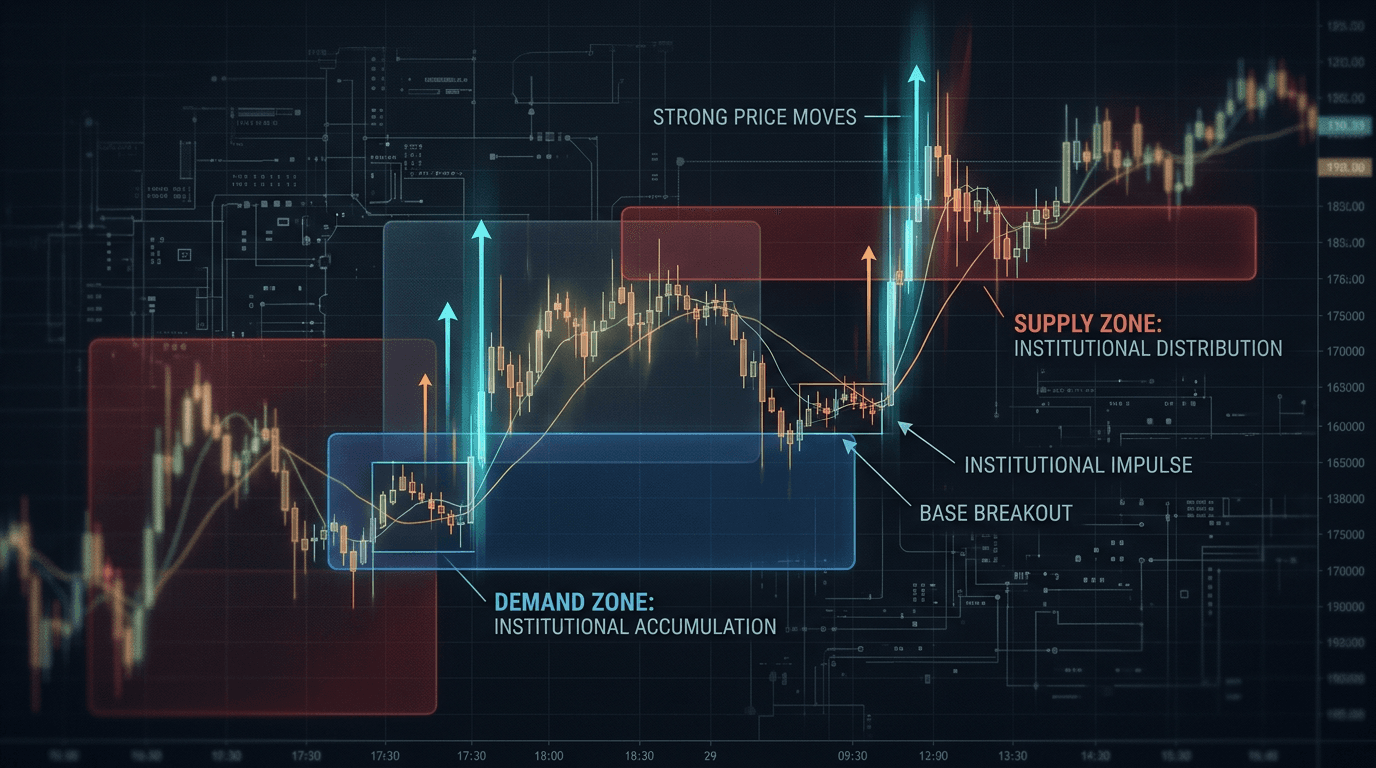
Supply and demand zones — defined as price levels where institutional order flow caused a sharp directional move away from a base of price consolidation — represent one of the most durable concepts in technical analysis. According to research published in the Journal of Finance by Grinblatt and Keloharju (2001), institutional investors systematically accumulate positions at price levels where prior reversals occurred, confirming that large-order clustering at specific price levels is not random but reflects deliberate liquidity management. Unlike traditional support and resistance lines drawn through price closes, supply and demand zones mark the origin points of explosive moves — the exact levels where unfilled institutional orders are most likely waiting to be executed when price returns.
Supply and Demand Zones: How to Trade Them Profitably

What Supply and Demand Zones Are (and How They Differ from S/R)

Supply zones are areas where prior selling was so aggressive that price left the zone rapidly, creating a sharp downward move. The logic: institutions with large sell orders couldn't fill everything at once, so the unfilled remainder stays at that price level as a pending order — a zone of 'supply overhang.' Demand zones work identically in reverse: price exploded upward from a base, leaving unfilled buy orders behind. The key distinction from traditional support/resistance is the origin of the move. Traditional S/R draws lines through prior lows and highs where price bounced. Supply and demand zones mark the consolidation base before the explosive move — the actual location of the institutional order cluster, not just where price happened to turn.

  • Demand zone: base of consolidation before a sharp explosive upward move
  • Supply zone: base of consolidation before a sharp explosive downward move
  • The sharper and faster the move away from the zone, the larger the unfilled orders
  • First return to a fresh zone has highest probability — zones weaken with each test
  • Zones differ from S/R lines: they mark order origin, not just price reversal points

How to Identify Valid Supply and Demand Zones

Valid zones share three characteristics: a tight consolidation base (the 'basing' candles), a sharp explosive move away from that base (the 'departure'), and a return to the zone on lower momentum. The tighter the consolidation before departure, the more concentrated the unfilled orders. The steeper the departure move, the larger the order imbalance that caused it. A zone with a 3-candle tight base followed by a 10-candle trending move is a high-quality zone. A zone with a 15-candle wide base and a modest 3-candle move is a weak zone. Zone freshness matters too: a zone that has never been retested has all its original unfilled orders intact, making it highest probability. A zone that has been tested once is weaker. A zone tested three or more times should be considered broken and discarded.

  • Tight consolidation base (2–5 candles) + sharp departure = high-quality zone
  • Wide, messy base + small departure = low-quality zone, skip it
  • Fresh (untested) zones have the most unfilled orders — highest probability
  • Each test of a zone partially fills orders and reduces its strength
  • 3+ tests of a zone = consider it broken, remove from your charts

Trading Demand Zones: Entry, Stop, and Target

When price returns to a demand zone from above, you have two entry approaches: limit orders placed at the top of the zone (aggressive) or market entry on a confirmation candle at the zone (conservative). Aggressive entries offer better risk-reward but more frequent stop-outs. Conservative entries require seeing a rejection candle (pin bar, engulfing, or strong close off the zone low) before entering. Stop placement: one average true range (ATR) below the bottom of the demand zone. If the zone has truly failed, price will break its low with momentum — your stop at the zone low captures this without getting clipped by normal wick behavior. Target: next supply zone above, or a 2:1 to 3:1 risk-reward minimum. Never hold a demand zone trade into the next supply zone without a clear plan.

  • Aggressive entry: limit at top of demand zone, stop below zone low
  • Conservative entry: wait for rejection candle, then enter on confirmation
  • Stop: 1 ATR below the zone low — captures failed zones without noise stops
  • Target: next supply zone above, or minimum 2:1 risk-reward
  • Reduce size on zone re-tests: first test gets full size, second gets half

Which Timeframe to Use for Supply and Demand Zones

Supply and demand zones exist on every timeframe, but their reliability is proportional to the timeframe on which they formed. A weekly demand zone will influence price more powerfully than a 5-minute demand zone, because the order clusters that formed it were larger and more institutional. The best approach is top-down analysis: identify the major zones on the weekly or daily chart first, then drop to the 4-hour or 1-hour chart to find the zone's exact entry boundaries, then use the 15-minute chart for entry timing. Avoid looking for zones exclusively on low timeframes (under 15 minutes) — these zones are populated by retail traders, not institutions, and lack the order-flow depth to reliably hold.

  • Weekly/daily zones: highest probability, slowest to form, largest moves
  • 4H/1H zones: good for swing traders, balance frequency and reliability
  • 15-minute zones: useful for entry timing within a higher-timeframe zone
  • Sub-15-minute zones: retail-dominated, low probability, avoid as primary zones
  • Top-down approach: identify zones on weekly → confirm on daily → enter on 1H/15m

Why Most Traders Fail with Supply and Demand Zones

The single biggest mistake is drawing too many zones. When every swing high and low gets labeled as a zone, you end up with 20+ zones on a chart and no clarity about which ones matter. The correct discipline is to draw only the highest-quality zones: tight base, sharp departure, fresh. A good daily chart should have 2–4 active zones maximum. The second mistake is ignoring trend context. Buying demand zones in a strong downtrend is fighting the dominant order flow — most of those demand zones will fail. The highest-probability trades are demand zones in uptrends and supply zones in downtrends. Trading with the trend increases zone success rates dramatically. Finally, failing to track zone performance in your journal means you never learn whether your zone identification actually works — you just feel like it does.

  • Draw only 2–4 high-quality zones per chart — more zones = less signal
  • Never fight the macro trend: demand zones in downtrends fail more often
  • Highest probability: demand zones in uptrends, supply zones in downtrends
  • Track every zone trade: zone quality rating, test number, outcome
  • Review zone performance monthly to calibrate your identification criteria

Related Resources

FAQ

?What is a supply and demand zone in trading?

A supply zone is a price area where aggressive selling previously caused a sharp downward move away from a consolidation base. A demand zone is the equivalent for buying — a base of consolidation from which price exploded upward. These zones represent areas where institutional orders were placed and likely remain unfilled, making them high-probability levels for price to react when revisited.

?How are supply and demand zones different from support and resistance?

Traditional support and resistance lines are drawn through prior price reversal points — the lows and highs where price turned. Supply and demand zones mark the consolidation base before the explosive move, which is where the institutional orders actually were. Supply and demand zones are broader areas (not lines), and they focus on the origin of the move rather than the turning point.

?How many times can a supply or demand zone be tested?

Each test of a zone partially fills the unfilled orders that created it. The first test is highest probability. The second test is lower probability. By the third or fourth test, most of the original order flow has been absorbed and the zone is considered weak or broken. A zone that has been tested three or more times should be removed from your chart.

?What is the best timeframe for supply and demand zones?

Higher timeframes produce more reliable zones because institutional order sizes are larger. Daily and weekly zones are the most powerful. For active traders, the 4-hour and 1-hour charts offer a good balance of frequency and reliability. The recommended approach is top-down: identify major zones on the daily/weekly, then use the 1-hour or 15-minute chart for entry timing.

Track Your Zone Trades and Build Proof of Edge

Tiltless lets you tag every supply and demand zone trade with zone quality, test number, and market context. After 50 trades, you have real data showing whether your zone identification actually produces edge — not just the feeling that it does.

Supply and Demand Zones: How to Trade Them | Tiltless