
Updated: 2026-03-08

Order Flow Trading: Reading the Tape Like a Pro

Order flow trading — defined as the analysis of real-time buy and sell orders to determine the current supply/demand imbalance before price moves — represents the closest any retail trader can get to seeing the market's true mechanics. According to research by Biais, Hillion, and Spatt (1995) published in the Journal of Finance, order book imbalances predict short-term price movements with statistical significance across equity markets, with aggressive market orders providing the strongest directional signal. This is the foundation of professional tape reading: reading not just where price is, but who is committing capital and how aggressively — and using that information to anticipate where price is going next.
Order Flow Trading: Reading the Tape Like a Pro

What Order Flow Is and Why It Predicts Price

Order flow is the real-time stream of buy and sell orders hitting the market. Every price move is caused by an imbalance in this order flow: more aggressive buying (market buy orders hitting the ask) drives price up; more aggressive selling (market sell orders hitting the bid) drives price down. The key insight is that passive limit orders sitting in the book do not move price — only aggressive market orders do. Order flow analysis tracks these aggressive orders to determine who is in control of the market at any given moment. When large market buy orders are consistently hitting without absorbing the ask, price will move up. When the same volume is hitting the bid without budging price, large sellers are absorbing — a warning signal for longs.

  • Aggressive market orders move price; passive limit orders do not
  • Bid absorption: large sell limit orders absorbing market buys = warning for longs
  • Ask absorption: large buy limit orders absorbing market sells = warning for shorts
  • Order flow imbalance (more aggressive buying than selling) predicts upward price movement
  • Velocity of aggressive orders matters: rapid high-volume buying signals momentum

Reading the DOM and Time & Sales

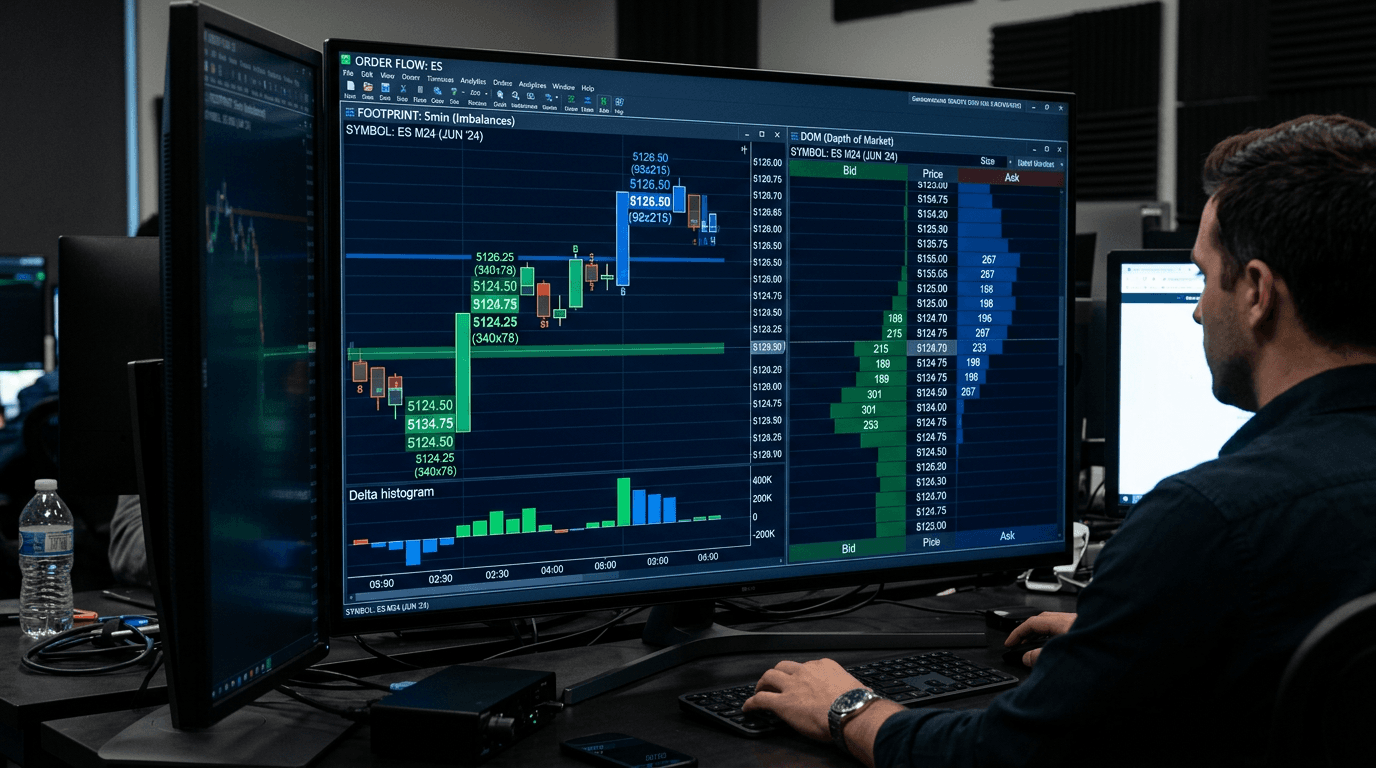
The Depth of Market (DOM) shows the current resting limit orders at each price level — the buy orders stacked below current price and sell orders stacked above. Time & Sales (the tape) shows every trade as it executes, with price, size, and aggressor side (whether the trade hit the bid or the ask). Together, these tools reveal the battle between buyers and sellers in real time. On the tape, look for three signals: 1) Size clustering — multiple large prints at the same price level indicate a significant player executing there. 2) Speed changes — the tape slowing down at resistance or accelerating through support signals a shift. 3) Print location — trades consistently hitting the ask (buying aggression) vs. consistently hitting the bid (selling aggression) tells you who is in control. Most tape readers focus on futures (ES, NQ, CL, NQ) and forex where the DOM is centralized — stock tape reading is complicated by fragmented liquidity across exchanges.

  • DOM shows resting limit orders above and below current price
  • Time & Sales shows every execution: price, size, bid or ask
  • Large clustered prints at one price = significant player executing
  • Tape speed acceleration = momentum; deceleration = potential reversal
  • Consistently hitting the ask = buying control; hitting the bid = selling control

Footprint Charts: Order Flow at a Glance

Footprint charts display order flow data inside each price candle — showing the exact volume traded at each price level, broken down by buy volume (traded at the ask) and sell volume (traded at the bid). This makes imbalances visible at a glance without reading a live tape. The most useful footprint patterns are: 1) Volume imbalances — a cell where buy volume dramatically exceeds sell volume (or vice versa), typically highlighted when the ratio exceeds 3:1 or 4:1. These show exactly where aggressive orders overwhelmed the opposition. 2) High-volume nodes — price levels within the bar where the most trading occurred, which become future support/resistance. 3) Unfinished auctions — bars that show very low volume at the high or low of the bar (the market moved through that price so fast that trading was minimal), suggesting the auction process is unfinished and price will return to complete it.

  • Footprint shows buy vs. sell volume at every price level inside a candle
  • Volume imbalance: 3:1 or 4:1 ratio signals aggressive directional commitment
  • High-volume node inside a bar = future support/resistance level
  • Low-volume extremes (unfinished auctions) = price will likely return to complete
  • Footprint charts require specialized software: Bookmap, Sierra Chart, NinjaTrader, or Exocharts

Three Order Flow Entry Signals That Work

Signal 1 — Absorption at key levels: When price approaches a major support level and the tape shows large sell prints hitting the bid without price moving lower, sellers are being absorbed by large limit buyers. This is the footprint of institutional accumulation. Wait for the absorption to stall the selloff, then enter long with a stop below the support level. Signal 2 — Delta divergence: Delta measures the difference between buy volume and sell volume in each candle. When price makes a new low but delta is positive (more buying than selling despite the new low), this is a strong bullish reversal signal — sellers are exhausted. Signal 3 — Iceberg detection: Icebergs are large orders that refresh repeatedly at the same price to hide their true size. They appear on the tape as consistent same-size prints at one price level. Identifying an iceberg means you have found where a large player is defending a level — trade in the direction they are defending.

  • Absorption: selling hits bid, price doesn't drop = large buyers defending the level
  • Delta divergence: new price low + positive delta = buyer exhaustion of sellers
  • Iceberg detection: repeated same-size prints at one price = large hidden order
  • All three signals are strongest when they occur at predefined S/R levels
  • Order flow signals confirm S/R levels — they don't replace the need for good level selection

The Real Limitations of Order Flow Trading

Order flow trading has three honest limitations that most gurus skip. First, it is latency-dependent — the fastest algorithms see order flow data before retail traders, which means the retail order flow trader is always playing catch-up. Second, spoofing distorts the DOM — large orders placed and cancelled in milliseconds create false impressions of supply and demand. In 2020, the CFTC fined JPMorgan $920 million partially for spoofing precious metals markets — a reminder that the DOM you see is not always the true order book. Third, order flow is most reliable in liquid, centralized markets: ES futures, NQ futures, crude oil futures, and major forex pairs. In thin or fragmented markets, order flow signals are noise-heavy and should be ignored. Most retail traders who fail at order flow trading fail because they apply it to the wrong instruments.

  • Latency disadvantage: algorithms see order flow before retail traders
  • Spoofing: large fake orders distort the DOM — don't treat every size print as real
  • Best markets for order flow: ES, NQ, CL futures and major forex pairs
  • Avoid order flow analysis in thin, low-volume, or fragmented markets
  • Use order flow as confirmation, not as the sole basis for trading decisions

Related Resources

FAQ

?What is order flow trading?

Order flow trading is the analysis of real-time buy and sell orders — specifically aggressive market orders hitting the bid and ask — to determine the current supply and demand imbalance before price moves. It uses tools like the DOM (Depth of Market), Time & Sales (tape), and footprint charts to read institutional intent and find high-probability entries.

?Is order flow trading better than technical analysis?

Order flow and technical analysis are complementary, not competing. Technical analysis identifies where to look (key support/resistance levels, trend structure). Order flow tells you what is happening at those levels — whether a level is likely to hold or break based on real buying and selling activity. The most effective traders use both: technical analysis for level selection, order flow for entry timing and confirmation.

?What software do I need for order flow trading?

For futures: NinjaTrader (with footprint add-ons), Sierra Chart, or Bookmap provide full order flow data including DOM, footprint charts, and tape. For forex: Exocharts or Bookmap. Most platforms require a data feed subscription in addition to the software license. Expect to spend $50–$200/month for a complete order flow setup.

?Can order flow trading work for stock traders?

Stock tape reading is significantly harder than futures because stock liquidity is fragmented across multiple exchanges and dark pools — you only see a partial picture of the order book. Some traders use Level 2 quotes and T&S for large-cap stocks with high volume (TSLA, SPY, NVDA), but it is much noisier than futures order flow. Most order flow traders focus on ES or NQ futures as proxies for overall market direction.

Journal Your Order Flow Trades with Context

Tiltless lets you tag each trade with the order flow signal you used — absorption, delta divergence, iceberg — and tracks your win rate by signal type. Find out which order flow setups you actually read correctly and which ones you're misinterpreting.

Order Flow Trading: Reading the Tape | Tiltless