
Updated: 2026-03-08

Trend Following Strategy: The Evidence-Based Approach to Riding Trends

Trend following is one of the most extensively documented profitable strategies in financial market history. The evidence is not anecdotal. A 2012 study by Moskowitz, Ooi, and Pedersen in the Journal of Financial Economics analyzed time-series momentum across 58 liquid instruments (futures, equities, currencies, commodities) over 25 years and found that a trend-following strategy produced a Sharpe ratio of 1.28 — significantly above buy-and-hold benchmarks. The Société Générale CTA Index, which tracks professional trend-following funds, has produced positive returns in 14 of the last 20 years, including during the 2008 financial crisis when trend followers gained 18% while the S&P 500 fell 38%. Trend following works because markets exhibit persistent serial correlation — yesterday's price direction has predictive value for tomorrow's direction — which is a well-documented empirical regularity across global markets. Yet most retail traders lose money trying to trend follow because they misidentify trends, enter too late, and exit too early. This guide explains how trend following actually works, the entry methods with the best historical evidence, how to size positions and manage risk in trends, and how to build a journaling system that measures your trend-following edge.
Track your patterns free →No credit card · Free forever
Trend Following Strategy: The Evidence-Based Approach to Riding Trends

How to Define a Trend (Without Being Wrong Most of the Time)

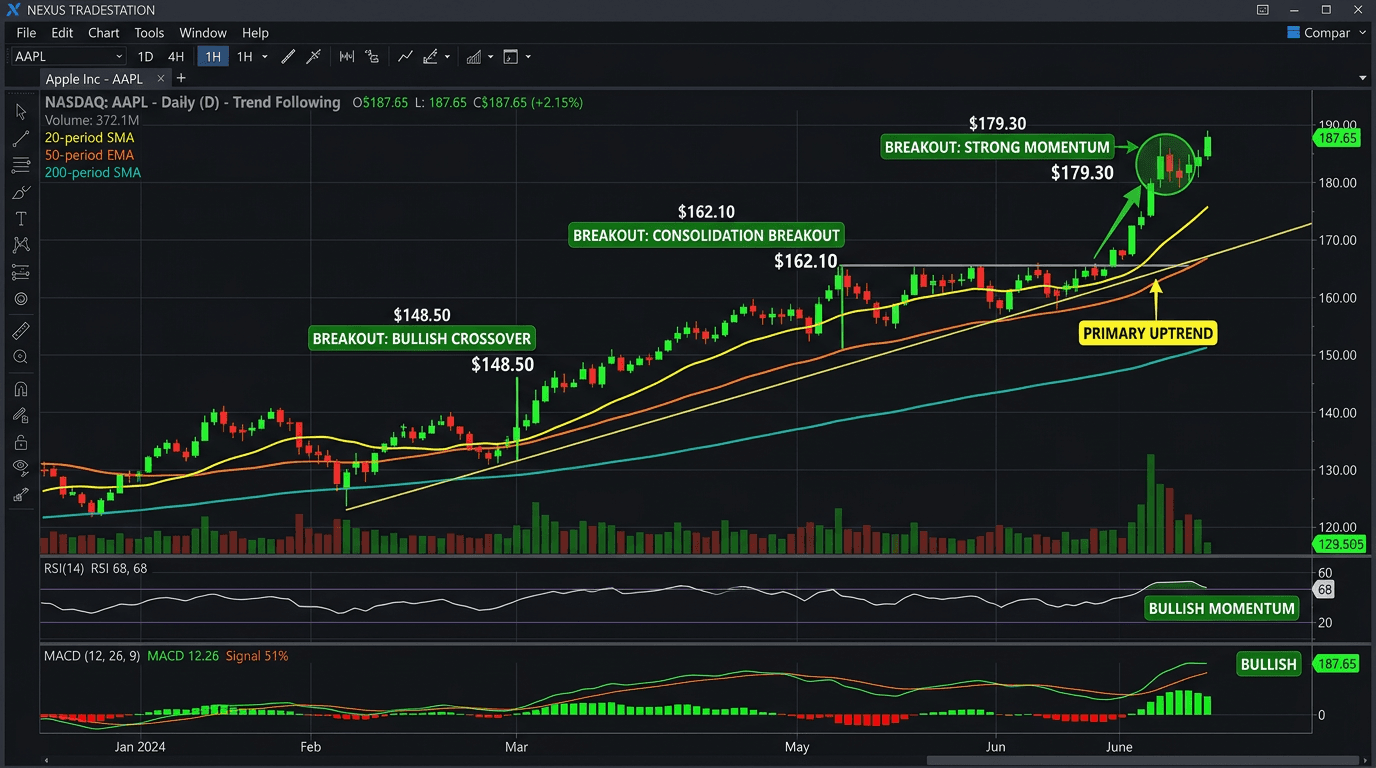
Most trend-following losses come from misidentifying trends. A series of higher highs and higher lows (uptrend) or lower highs and lower lows (downtrend) is the structural definition — but applying it requires judgment about which swings are significant. Using the Dow Theory framework, a primary trend consists of a series of impulse waves (the trend direction) punctuated by corrective pullbacks. The corrective pullbacks must not violate the prior significant swing low (in uptrends) or swing high (in downtrends). When a correction does violate that level, the trend structure is potentially broken.

Objective trend definitions reduce discretion and enable journaling. Common objective frameworks: (1) Price is above/below the 200-period moving average (trend direction = direction of MA). (2) The 50-period MA is above/below the 200-period MA (golden/death cross). (3) Price makes a 20-period high (Donchian Channel breakout). (4) ADX (Average Directional Index) > 25 indicates a trending regime. Use one definition consistently rather than switching between them based on which supports your current bias.

  • Structural definition: higher highs + higher lows (uptrend); lower highs + lower lows (downtrend)
  • Trend intact as long as pullbacks don't violate prior significant swing low/high
  • Objective method 1: price above 200 SMA = uptrend; below = downtrend
  • Objective method 2: 50 SMA above 200 SMA = bullish; below = bearish (golden/death cross)
  • Objective method 3: Donchian Channel 20-period high/low breakout = trend entry signal
  • ADX > 25 = trending market; ADX < 20 = choppy, ranging — avoid trend signals in low ADX

Trend-Following Entry Methods: Breakout, Pullback, and Momentum

Three entry methods dominate systematic trend following, each with different risk profiles and frequency.

Breakout entry: Enter when price makes a new N-period high (long) or low (short). The classic Turtle Trading system used 20-day breakouts for entry and 10-day breakouts for exit. Breakout entries are early in the trend but have lower win rates (40–50%) and require larger initial stops. They compensate with large average winners when trends extend.

Pullback entry: Enter during a retracement in an established trend. After a breakout above a key level, wait for price to pull back to the 20 EMA or 50 SMA, then enter on the first rejection of that moving average. Pullback entries have higher win rates (50–65%) and tighter stops but miss the initial impulse and are sometimes late to the trend.

Momentum entry: Enter when a momentum indicator (MACD histogram turning positive, RSI crossing above 50 from below, or rate of change exceeding a threshold) confirms trend strength. The RSI > 50 from below filter in a price-above-200SMA environment has a documented edge in equities research.

  • Breakout entry: new N-period high/low — early, low win rate, large potential winners
  • Turtle Trading system: 20-day high for entry, 10-day low for exit (long trades)
  • Pullback entry: enter on first rejection of 20 EMA or 50 SMA in established trend
  • Pullback entries: higher win rate (50-65%), tighter stops, miss the initial impulse
  • Momentum entry: MACD histogram positive, RSI cross above 50, rate of change threshold
  • RSI > 50 in price-above-200SMA environment has documented equity edge in academic literature

Track Your Trend Trades and Measure Your System's True Expectancy

Log each trend trade with entry method, trend filter, and R-multiple result. Tiltless shows you your actual average winner vs. loser so you can prove your trend system has edge — or find out why it doesn't.

Start Tracking Trend Trades — Free

Position Sizing and Exits: Where Trend Followers Actually Make Money

Trend following has an asymmetric return distribution — many small losses and occasional large winners. The system only works if you keep the small losses small and let the winners run. Both are primarily managed through position sizing and exit rules, not entry selection. The ATR-based position sizing method ensures that each trade risks the same dollar amount regardless of asset price or volatility: position size = (dollar risk per trade) / (entry price − stop price). When the stop is set at 2× ATR below entry, the formula produces a position that loses exactly the predetermined dollar amount if stopped out.

For exits, trend following systems use trailing stops rather than fixed targets. The classic approach: trail the stop at 2–3× ATR below the highest close since entry (for longs). This allows trends to breathe without exiting on normal pullbacks, while capturing the majority of the trend move. Fixed price targets underperform trailing stops in trend following backtests because they exit winners too early — before the trend has fully extended. The exit mantra: let winners run until the trend ends; cut losers before they grow.

  • ATR-based sizing: position size = dollar risk / (entry - stop); equalizes risk across volatility
  • Typical stop: 2× ATR below entry for longs — allows natural pullbacks without stopping early
  • Use trailing stops, not fixed targets — fixed targets cut trends too early
  • Trailing stop method: trail 2-3× ATR below the highest close since entry
  • The edge is in letting winners run — most trend-following P&L comes from 20% of trades
  • Accept 40-50% win rates — the average winner must be 3× the average loser minimum

Why Trend Followers Fail: The Psychological Traps

The most common trend-following failure mode is exiting the trend after the first significant pullback. Trends are not straight lines — they contain corrections of 20–40% of the prior move within intact trend structures. Traders who enter a breakout, ride a 15% move, then watch a 10% correction often exit 'to protect gains' — only to watch the trend continue for another 40%. The correction felt like a reversal. It was a pullback.

The second failure mode is entering reversals thinking they are trends. In a choppy, low-ADX market, every swing looks like a trend in the making. The fix: enforce an ADX > 25 filter before any trend-following entry. In low-ADX environments, mean-reversion strategies outperform trend-following strategies. Disciplined trend followers turn off their systems in choppy markets rather than taking losses from false signals.

The third failure mode is giving up after a drawdown period. All trend-following systems go through extended drawdown periods — typically 3–12 months — when markets are choppy and no trends develop. The documented behavior: most retail traders abandon their trend-following system during the worst drawdown, immediately before the market enters a trending regime where the system recovers. Sticking with a backtested, positive-expectancy system through drawdowns requires journal evidence of historical edge — not just abstract conviction.

  • Do not exit on corrections — trends pull back 20-40% of prior move and continue
  • Most trend-following failures occur at the exit, not the entry
  • ADX < 25 = choppy market — turn off trend-following entries, switch to mean reversion
  • Extended drawdown periods (3-12 months) are normal — do not abandon a proven system
  • Most retail traders quit their trend system at the worst drawdown, before the recovery
  • Journal your system's historical expectancy — use that data to maintain discipline in drawdowns

How to Journal Trend-Following Trades

Trend following is well-suited for systematic performance tracking because the entries and exits are rule-based. For each trend trade, log: the entry method (breakout, pullback, momentum), the trend definition met at entry (price above 200 SMA, ADX reading, moving average alignment), the ATR at entry and stop distance, whether the trade was exited by trailing stop or manual override, and the R-multiple result (actual gain/loss divided by initial risk).

The most important metric: your average R-multiple winner vs. loser. If your system produces a 45% win rate but your average winner is 4R and your average loser is 1R, your expectancy is: (0.45 × 4) − (0.55 × 1) = 1.8 − 0.55 = 1.25R per trade. That's a strong positive expectancy system. If you find yourself manually exiting winners before the trailing stop triggers, measure the cost — how many R-multiples are you leaving on the table? Most trend followers are surprised to discover that discretionary early exits reduce their average winner from 3R to 1.5R, turning a positive-expectancy system into a neutral or negative one.

  • Log entry method, trend filter met at entry, ADX reading, ATR at entry
  • Record whether exit was rule-based (trailing stop) or manual override
  • Calculate R-multiple for each trade: actual gain/loss ÷ initial risk
  • Key metric: average R winner vs. average R loser — expectancy = (win% × avg win R) - (loss% × avg loss R)
  • Track early exits separately — measure R-multiples you're leaving on the table
  • Most trend followers lose edge through discretionary early exits, not bad entries

Related Resources

FAQ

?What is trend following in trading?

Trend following is a systematic trading strategy that enters positions in the direction of established price trends and holds them until evidence of trend reversal. The core principle: markets exhibit momentum — assets that have been rising tend to continue rising, and falling assets tend to continue falling. Trend followers use objective criteria to define trends (moving averages, price breakouts, ADX), enter on confirmed signals, and use trailing stops to capture the majority of the trend move before exiting.

?Does trend following actually work?

Yes — trend following has one of the strongest empirical track records of any systematic trading approach. The Moskowitz, Ooi, and Pedersen (2012) Journal of Financial Economics study found a Sharpe ratio of 1.28 for time-series momentum across 58 instruments over 25 years. Professional CTA (Commodity Trading Advisor) trend-following funds have outperformed equity markets during major bear markets, including 2008 and 2022, because trends in commodities, currencies, and bonds develop when equities decline.

?What timeframe works best for trend following?

Longer timeframes produce stronger trend-following evidence. Swing trading timeframes (daily charts, 2–8 week holding periods) and position trading timeframes (weekly charts, 1–6 month holding periods) have the most documented edge. Intraday trend following is significantly harder — transaction costs are higher, noise-to-signal ratios are worse, and trends develop and reverse within single sessions. Institutional trend-following funds predominantly operate on daily and weekly timeframes.

?How do you manage risk in trend following?

Trend following uses ATR-based position sizing to equalize dollar risk across all trades regardless of volatility. Position size = (dollar risk per trade) / (entry price − stop price). Stops are typically set 1.5–2× ATR below entry (for longs). Exits use trailing stops — trail 2–3× ATR below the highest close — rather than fixed profit targets. The system accepts many small losses (40–55% win rate is typical) in exchange for occasional large winners when trends extend significantly.

Track Your Trend Trades and Measure Your System's True Expectancy

Log each trend trade with entry method, trend filter, and R-multiple result. Tiltless shows you your actual average winner vs. loser so you can prove your trend system has edge — or find out why it doesn't.

Trend Following Trading Strategy: Complete Evidence-Based Guide